Nothing is strange to a child: on Solenoid
Lice came before the fourth dimension in Cărtărescu’s Solenoid. The novel opens at the protagonist’s scalp, where metaphysics touches skin. Before the buried solenoids and levitating bodies, there is a schoolteacher, over a sink, combing lice from his hair and noticing, with horrible calm, the shared organic indignity of their bodies and his. Revelation grows from itch; cosmic escape begins as infestation. The surreal and the metaphysical stem from the real and physical. Moving deeper through the pages of Solenoid, however, makes one realise quickly that surrealism is too clean a word for what Cărtărescu has created. Surrealism assumes a stable reality later breached by dream. Solenoid hangs from a more extreme position: the normal reality is the same thing as the strange dream.
Cărtărescu lays this bare in Solenoid:
Nothing is strange to a child, because he lives in the strange; thus dreams and old memories seem made from the same substance. (p. 148)
Childhood, in this formulation, has little to do with innocence, nostalgia, or a decorative reservoir of wonder. It is a cognitive condition before the world’s appearances and happenings have been sorted into permissible and impermissible categories; before dream, memory, shame, illness, hallucination, and fact have been assigned to separate drawers. The adult mind, schooled by language, fear, work, embarrassment, and the ordinary police force called ‘other people’, later declares that sorting sanity. Cărtărescu writes from before the drawers close. Merleau-Ponty, in Phenomenology of Perception (1945), argued that the body’s engagement with the world precedes all categories of subject and object, that perception is neither a thought nor a mechanical recording but a lived participation in the world’s texture. Solenoid pushes further: not just perception but everything (memory, fact, dream, bodily disgust, metaphysical longing) belongs to a single pre-sorted substrate, and what adults call ‘reality’ is simply the subset they agreed to keep.
That is why the loose category of surrealism only gets one so far. It still thinks in terms of breach: reality here, dream there, impossibility arriving as a foreign body. Solenoid’s premise is more radical. Irina floating above the bed is not a violation of the room so much as one of the room’s hidden laws becoming briefly visible; the solenoids beneath Bucharest do not make the city strange so much as expose the fact that its ordinary surfaces were never sufficient. The impossible events arrive less as intrusions than as belated evidence that the world was never settled.
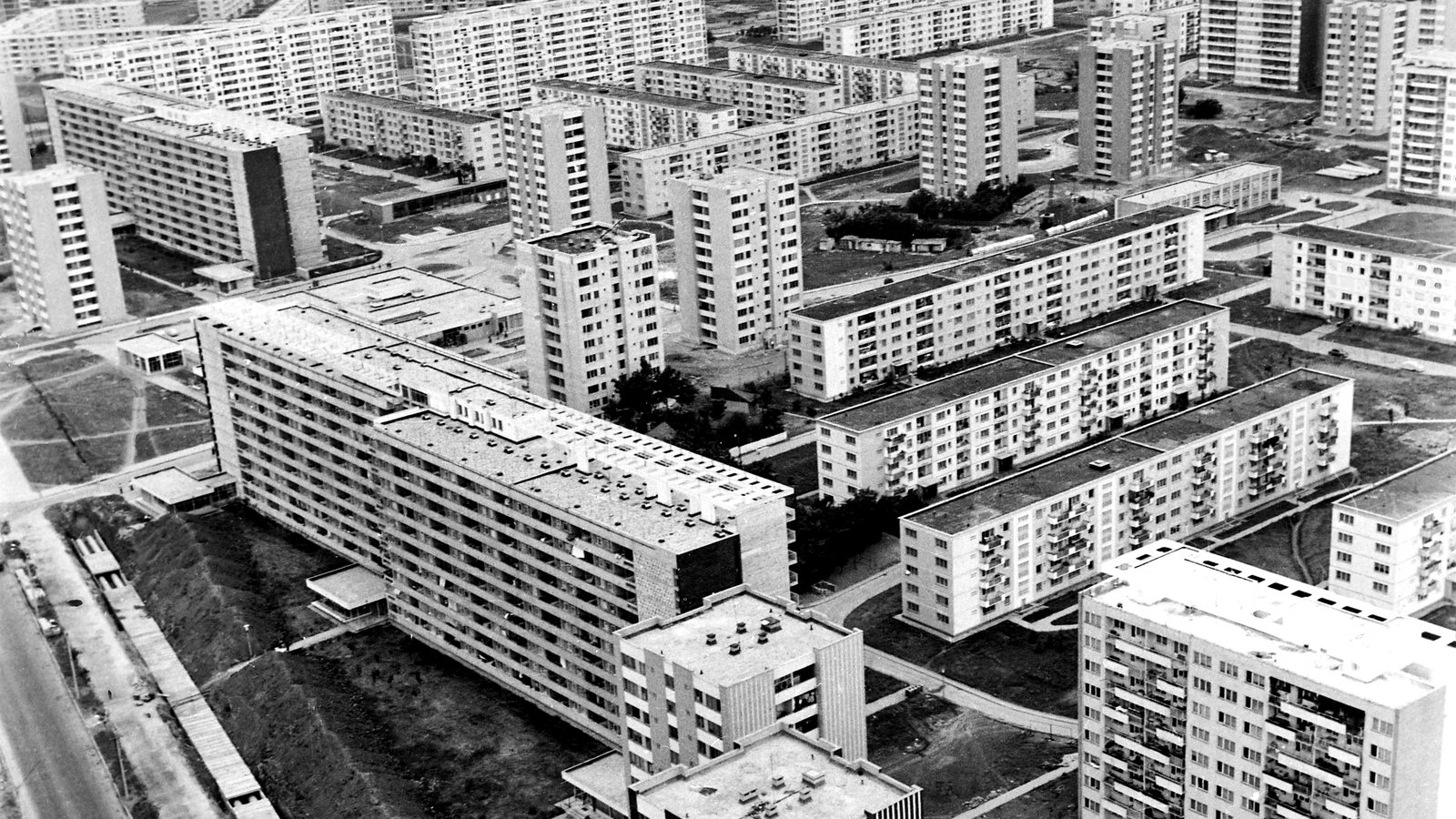

The protagonist rides tram 21 to the edge of Bucharest, passes the water tower and the pipe factory with its shattered windows, and arrives at a street where ‘the neighborhood’s arborescence produced these fruits of an exuberant, creole sadness’. He finds the boat-shaped house at the end of a lot full of rusted springs and refrigerator carcasses. It is ‘not actually boat-shaped, but a shape that stubbornly resists description’, an upside-down pyramid topped by a crooked watchtower, wrought-iron maidens flanking the entrance, a round window that ‘glows manically in the sun’. He calls it an ‘ashen tesseract’, and sees in it his ‘ideal self-portrait’. Gaston Bachelard, in The Poetics of Space (1958), argued that a house is not merely a building but the first universe of the human imagination, that dwelling and interiority are the same structure experienced from two sides. Cărtărescu has said, in a 2022 interview, that he recreated and invented Bucharest, making it ‘an alter ego, a twin, a state of mind’. The book’s Bucharest is not ‘realistic city plus supernatural disturbance’; it is tramlines, factories, hospitals, schools, apartment blocks, vacant lots, libraries, and childhood routes already distorted by attention. The protagonist’s school corridors expand into nightmarish passages that feel ‘secreted rather than built’. Setting turns into organ. When the city’s topography becomes indistinguishable from the topography of thought, it is because Cărtărescu has made thought topographical in the first place: routed, blocked, infected, electrified, full of chambers one did not know one had entered.
In Part 1, a foreign tourist gives the seven-year-old protagonist a gilded copper coin in a metal frame, with the letters A, O, R on one side and M, U on the other. ‘Several days passed before I solved the mystery when on a whim I flicked the coin and it spun so quickly in its metal frame that it became a gold sphere, as free and transparent as a dandelion, with the ghostly word AMOUR in the middle.’ The spinning adds a dimension; the flat disk becomes a sphere, and the sphere, if spun again, would become a hypersphere. Only the rotation, the vertigo, the refusal to look at one side at a time, produces the word that was always there. ‘The meaning lies in the hypersphere’, Cărtărescu writes, ‘in the unnamable, transparent object that results from spinning the sphere in the fourth dimension.’ And immediately the novel names its intellectual ancestor: ‘But here I’ve come, much too quickly, to Hinton and his cubes.’
Charles Howard Hinton, the Victorian mathematician who spent his life trying to visualise four-dimensional space, married Mary Ellen Boole, one of five daughters of the logician George Boole. Another Boole daughter, Ethel Lilian, wrote The Gadfly (1897) and later married Wilfrid Voynich, the antiquarian who purchased the unreadable manuscript now named after him. Solenoid follows this chain with conspiratorial precision: the protagonist weeps over The Gadfly at twelve, years before learning that its author’s family connects to the fourth dimension on one branch and to the indecipherable manuscript on another. The novel finds the chain and asks whether it is coincidence or architecture. ‘How can you not think’, the narrator demands, ‘that the series Gadfly–Boole–Hinton is a sign, a model trajectory, a map for your great escape plan? And how can you ascribe to chance the fact that Ethel eventually married the one found, after a rocambolesque, six-century adventure, by the manuscript that today bears his name?’
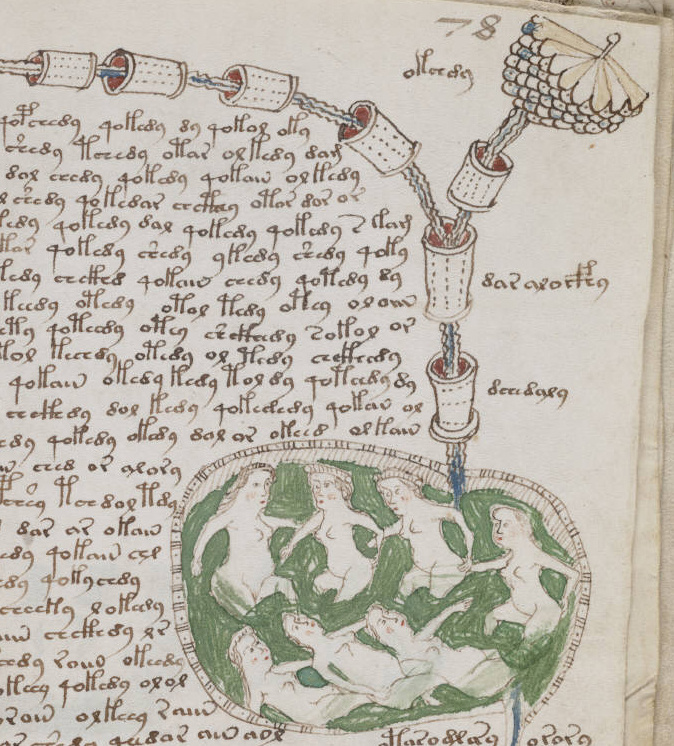

Reading Solenoid, one repeatedly loses confidence in the distance between Cărtărescu’s creations and the historical record. Ethel Lilian Voynich, Charles Hinton, the Voynich manuscript, Nicolae Vaschide’s controlled-hanging experiments, Nicolae Minovici’s auto-asphyxiation research: each is real, each has been through the novel and returned with its surfaces changed. On my first encounter with the Voynich manuscript inside Solenoid, I presumed it was simply another of Cărtărescu’s inventions; only later did I learn about the real folios in the Beinecke Library. Borges, in ‘Tlön, Uqbar, Orbis Tertius’ (1940), imagined an encyclopaedia of a fictional planet whose objects begin materialising in the real world. Solenoid performs the inverse: real-world objects (the Voynich folios, Hinton’s coloured cubes for training four-dimensional intuition, Tesla’s electromagnetism) enter the fiction and lose their factual neutrality. Knowledge and hallucination stop being opposites. Facts in this novel feel like objects that have passed through dream and returned heavier.
The same doubling reaches biography. The protagonist’s failed poem matters more than plot summary makes it sound. In the novel, The Fall is humiliated at the Workshop of the Moon and the protagonist thereafter becomes a schoolteacher; the text describes the moment as ‘the crucial switch point of my life’, a railway junction where two creatures were born from one, diverging along tracks that ‘would never meet again’. In Federico Perelmuter’s account, the fictional The Fall shadows Cărtărescu’s The Levant: the real workshop reception was rapturous where the protagonist’s is ruinous. This is not a clever autobiographical key. It is the book’s metaphysics at the scale of a life. A doubled city finds its narrator in a doubled biography; the book is built from the branch that did not happen, or perhaps from the life that literary institutions refused to certify. Fernando Pessoa spent decades writing through heteronyms (Campos, Caeiro, Reis), each an entire invented literary life that the real man could not live in one body. Cărtărescu does something similar but through negation: his narrator is the self that failed, writing from inside failure’s specific porosity.
Cărtărescu’s handling of the protagonist’s failure also refuses the easy novelistic consolation. The cheap version makes failure a romance: rejection purifies the artist, success is made vulgar by comparison. Solenoid takes a different route. Failure makes its narrator porous, open to resentment, revelation, tenderness, grandiosity, self-pity, disgust, and forms of attention that a cleaner life might have sealed off. ‘Because I am not a writer’, the narrator declares late in the book, ‘I have the unsoundable privilege to write my manuscript from within, surrounded by it on all sides, deaf and blind to anything that might distract from my penal labor.’ Porosity is its own category-failure: the narrator cannot keep his emotional states in separate compartments any more than Bucharest can keep its surfaces from splitting open. And the novel itself, this enormous manuscript that the narrator insists has no readers and will never be published, exists only because the literary life was refused. The writing is generated by the wound it cannot heal.
At sixteen, the protagonist finds a parasitological treatise in an agricultural engineer’s house and discovers, ‘within the world of the animals that infest your body, devouring you from without and within, a great, somber poem’. The book’s plates show ‘the saga of creatures not of our world, perverse metamorphoses, improbable transits between heteroclite hosts, diabolical techniques impregnated by a malign genius’. He sees the angelic infant parasite that eats a tongue and takes its place, the transparent larvae that rummage through the hippocampus and alter memories, the crustacean parasite that hollows out a hermit crab and moves its shell under a foreign will. Years later, the novel restages these creatures as dioramas the size of tigers and elephants. The protagonist stares at a mite ‘large as sheep, with beak-shaped legs where twisted flagella burst out, with potbellied bodies full of hair’ and arrives at a philosophical collapse: ‘This is what we all are, blind mites stumbling along our piece of dust in an unknown, irrational infinity, in the horrible dead end of this world.’ We think we have access to the structure of the world, but ‘we continue to live without self-consciousness and without understanding, digging tunnels through the skin of God, causing him nothing but fits and irritation’.
I was surprised, reading the Chicago Review interview, to find Cărtărescu invoking soma sema (the body as prison) to describe Solenoid. After hundreds of pages of dissolved categories, here was the author reaching for one of the oldest dualisms in philosophy. My materialist reflex, much reinforced by his version of Bucharest, resists the clean separation. Mind happens as body, through history, environment, appetite, injury, and other people. Yet one can reject the soul-body partition and still feel the insult of embodiment: a capacity for infinity tied to skin, sweat, spinal pain, teeth, infection, appetite, decay. Drew Leder, in The Absent Body (1990), argued that we forget our bodies precisely until they malfunction; the body becomes present to us as obstacle, as pain, as limitation. Cărtărescu builds on this with monstrous precision. The body does not merely interrupt thought; it produces the exact feeling that makes the Platonic metaphor persuasive. The cage and the desire to escape the cage are made of the same tissue.
Kafka, of course, understood this. Gregor Samsa wakes to find his body has become the obstacle, and all his prior social arrangements (the alarm clock, the train schedule, the sample case) are revealed as having been temporary agreements with a body that could at any moment refuse cooperation. Cărtărescu’s body-horror is less sudden but equally structural: lice, mites, sweat, navels, dental shame, bodily fluids, illness, the obscene smallness of organisms keep dragging transcendence back through pores. The fourth dimension matters because the third dimension has teeth, skin, infection. The desire to escape existence is generated by existence at its most intimate.
In 1925, according to the novel, a man named Nicolae Borina returned from America to Bucharest. He had worked under Tesla in the United States, studying electromagnetism; he had ‘modernized the electric trams, studied escalators, trying to produce electricity at almost no cost by combining coils and magnets’. He practised ‘unipolar medicine’ using a device of his own invention: ‘a pink spiral and a blue one (made of a very pure copper that we painted and insulated) in a double helix’, two metres tall and wide enough to stand inside, which cured ‘every sickness of the soul and body’. He built his house over a node in the earth’s magnetic field, dug down to the bedrock, and placed in the foundation ‘a torus shape, nine meters in diameter’, sixteen layers of copper coils around an iron core, manufactured in Basel and ‘brought into the country by rail, on a special train’. The machine never worked. The wonder ‘did not appear’. He sold the house decades later to the protagonist, who eventually discovered the scarlet button above the bed that activated the solenoid and lifted Irina, naked and glistening, to float a metre above the sheets.
Ben Hooyman’s labyrinth is the right spatial metaphor for the bewilderment, but a labyrinth only describes how one gets lost. The title’s object describes how the novel holds together. A solenoid is a coil that produces a magnetic field when current passes through it; Michael Faraday, in the 1830s, first described the invisible lines of force surrounding such a coil, the field that exists in the space around the wire rather than in the wire itself. Cărtărescu builds narrative the same way, by making recurrence generate force. Episode coils around episode, dream around memory, the fictional Bucharest around the historical one. Then the loops begin to carry friction. Failed life coils around successful life; science around mysticism; disgust around tenderness; longing for transcendence around the body that produces the longing. The movement is induction rather than ordinary progression. Repeated scenes accumulate charge before they disclose a system.
This is also why Solenoid feels irreducible to plot. The book’s true unit is not the event but the charged scene: the poetry humiliation, the classrooms, the endless corridors, Colentina and the factories along the tramline, the impossible domestic machinery of the house, Palamar’s mites under the lens, the sense that Bucharest has always had an underside waiting for the right pressure. Even the most outlandish images retain a practical texture: a button pressed, a route followed, a body placed under observation, a manuscript card found in a library catalogue. These scenes do not assemble into argument in a linear way. They slowly alter what the reader is willing to accept as evidence.
And the novel knows this about itself. In the finale, the Picketists (a neighbourhood movement that protests death itself, whose members carry Dylan Thomas’s ‘Do not go gentle into that good night’ as their anthem) march into the underground hall of the great dental chair where Damnation, an obsidian goddess, awaits. The solenoid is revealed along the curved walls, humming. The dome opens to stars. The narrator, following in the steps of the martyred Virgil, activates the mechanism, and from the objects of his life (baby teeth, photographs, the Voynich manuscript, Vaschide’s Sleep and Dreams, Minovici’s hanging plates) a tesseract is produced: Hinton’s dream realised as a shining impossible object, projecting onto the wall ‘a door pure and simple, without features, a conceptual door, a door from the world of ideas’. The grand egress. Escape from the prison of three dimensions. The novel’s principle has been building towards this door for nearly seven hundred pages.
And the narrator refuses it. He burns his manuscript in the pit of flames, ‘one by one, I let the notebooks fall’, and chooses to stay with Irina and their daughter. ‘Only as my manuscript disappeared into the flames did I begin to feel I truly had a life.’ Then Bucharest tears from the earth and rises into the sky (the solenoids, all activated together, have ripped the city free), and the narrator watches from beyond the belt road as his world ascends without him. The closing lines: ‘We will stay there forever, sheltered from the frightening stars.’
A novel whose formal principle is category dissolution, whose structure enacts escape from the ordinary, whose every image argues for the insufficiency of the three-dimensional world, ends with a man choosing to remain inside limitation. The sacrifice of the manuscript is the sacrifice of the novel’s own logic. Kierkegaard, in Repetition (1843), proposed that the self is formed not through forward motion but through the courage to return to what was lost, to choose again what was first given passively. The narrator’s refusal of the tesseract-door is this kind of repetition: he chooses embodiment, love, mortality, the very constraints that generated the longing to escape. The cage refuses to open because the man inside it has decided the cage is also a home.
If the book’s meanings keep pressing against available language, translation becomes its final test, and another boundary that turns out to be permeable. Sean Cotter’s English is inseparable from that pressure. I do not read Romanian; my Cărtărescu is therefore necessarily Cotter’s Cărtărescu. I cannot judge fidelity from outside his language. I can judge whether the English has pulse, density, and pressure sufficient to carry six hundred and seventy pages of category-dissolution without flattening them into prestige-literary mist. A novel like this could die in translation in several ways: it could become all ornament and no pulse, all archive and no fever, all strangeness smoothed into respectability. Gregory Rabassa, translating García Márquez’s One Hundred Years of Solitude (1970) from the Spanish, faced a version of this problem: sentences that pile subordinate clause upon subordinate clause, spiralling forward through generations, and the translator must decide at every comma whether to break the spiral for English ‘readability’ or keep the pressure. Cotter keeps the pressure. His sentences stay dense without becoming airless. They also preserve inquiry, the sense that every object has to be touched, worried, opened, suspected. The sentence that grants this review its title (‘Nothing is strange to a child, because he lives in the strange; thus dreams and old memories seem made from the same substance’) has to sound almost childishly plain while carrying a metaphysical insult. Cotter manages to hold both plainness and weight in friction, scholarship and hallucination, the archive and the dream, without letting either side smooth into the other.
Solenoid is one of the great reading experiences of my life. Across nearly seven hundred pages, the book did not give me a system. It gave me a way of suspecting one: press hard enough on reality’s walls and something might answer from the other side. After the drawers had been pulled open and emptied onto the floor, I found I was willing, again, to take the strange seriously. And then, at the very end, having earned the right to leave, the novel chose to stay. That is closer than I expected to come, in adult life, to childhood.