Danya
I found him through a subreddit recommendation, some time during my first serious month of studying openings. The video was a Theory Speed Run episode on the Rubinstein Variation of the French Defence; I cannot say what drew me in first, but within three minutes I had stopped the video, reset to the beginning, and opened a board on Lichess to follow along. Something about the way that he spoke was different from anything else I had encountered in chess content: thinking aloud, wide open, moving at a pace that I could follow without ever feeling that it had slowed down for me.
That was Danya. Daniel Naroditsky: GM, commentator, teacher, and by the time that I found him already one of the most beloved figures in online chess. The body of work that he left behind is staggering for someone who was twenty-nine. Speedruns from beginner to master, theory speedruns through entire opening systems, puzzle-solving sessions where he would think through a position’s logic from first principles instead of just announcing the answer, opening experiments where he tested ideas live and let the audience watch them fail or succeed in real time. He was Chess.com’s lead commentator for years; his calls during the Speed Chess Championship and the Bullet Championship are still circulating, still quoted, still remembered by people who watched them once. He wrote puzzle columns for The New York Times. He published his first chess book at fourteen. But what hooked me, beyond the volume and the credentials, was the way that he wove the game’s history into the teaching. A quiet pawn manoeuvre would become an anecdote about Petrosian; a kingside attack would open a door to Alekhine or Tal. He answered questions from chat with a patience that I had never seen in anyone who was simultaneously playing at grandmaster speed, and the whole thing had the quality of sitting across from someone who wanted me to see what he could see.
My King’s Indian as Black still faithfully follows his teaching. I play rapid on Lichess almost every day, under the same username that I have used since I was fifteen. I started as a blitz player; Danya was the reason that I switched to longer time controls, because he made me understand that speed without understanding is just pattern-matching, and that pattern-matching without understanding eventually stops working. I am around 1800 now. The openings that I choose and the way that I think through positions carry his voice.
Danya’s childhood idol was Vladimir Kramnik, the former world champion. In the last two years of Danya’s life, Kramnik, seemingly unravelling, began accusing online chess players of cheating; first players that had beaten him in online tournaments, then younger grandmasters in general, then nearly anyone. There was no evidence. Chess.com investigated and cleared every name. The accusations grew wilder and more public: American grandmasters, Russian grandmasters, teenagers with spotless records. Danya was among them. His idol, the player whose games he had studied since childhood, accused him publicly of being a fraud.
By every account that matters, Danya was one of the most honest players in the game. In his final stream, he spoke about what the accusations had done to him: ever since the Kramnik affair, he said, he felt that when he started performing well, people assumed the worst. Over those two years, I watched, along with everyone who followed him, as the toll became visible; he cried on stream, held his head after losses, and his composure cracked in ways that were hard to miss. But when he turned to the camera to answer a question from a beginner about why their knight was misplaced, he was the same person that he had always been: patient, warm, careful, precise. He never let the cruelty bleed into the teaching. I think about that constancy more than about any brilliancy, any speedrun record, any tournament result.
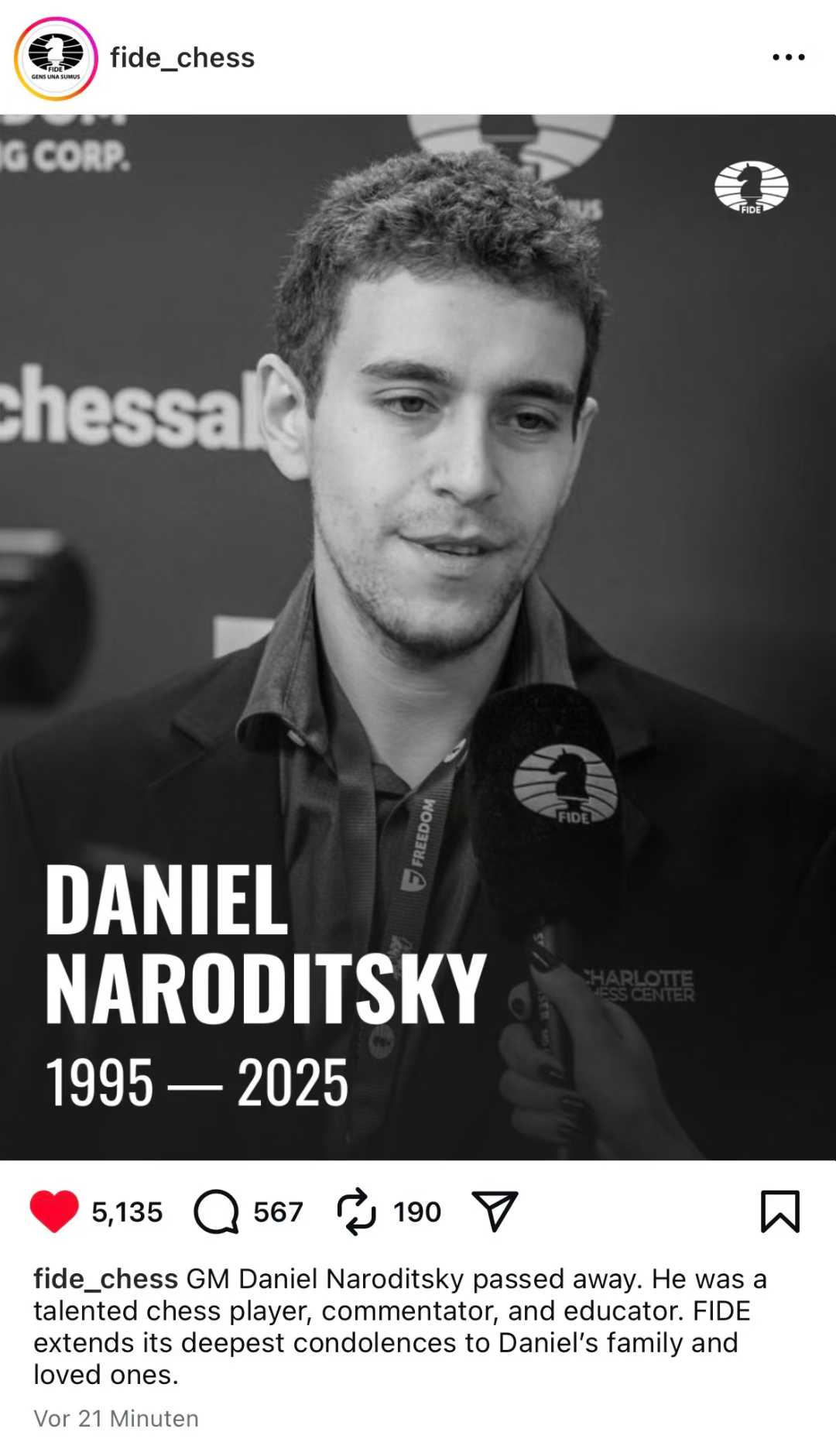
I was about to eat lunch in the lab when I saw it on FIDE’s Instagram. I put the food down and cried for half an hour. He was twenty-nine. Within hours a clip from his final stream was circulating everywhere: Danya speaking, visibly exhausted, about how the accusations had made him feel that performing well would only invite suspicion, that his reputation and his reason for waking up in the morning were the same thing, and that both were under siege. The clip keeps breaking my heart; I have watched it more than once and cannot bring myself to watch it again. At the U.S. Championship in St. Louis, where half the top players in the country were gathered, a round opened with a minute of silence. Hikaru Nakamura said that Danya was the best of them. Magnus Carlsen, who had played Danya on his wedding night and from the hospital while waiting for the birth of his child, called Kramnik’s pursuit of him appalling. In the days since, there has been speculation about the cause of death, there has been rage at Kramnik and at FIDE for tolerating his campaign for as long as they did, there has been an overwhelming tide of love from people who learned chess from a person who never once made them feel small for not knowing something. Nobody knows yet exactly what happened in Charlotte. He died alone in his apartment, having missed a flight to Colorado. The videos are still up, the voice still patient, and the French Defence Rubinstein Variation is still in one of my Lichess studies.