Doomed as dodoes
In October 1650, the Massachusetts General Court ordered a small theological tract burned in the Boston marketplace. Its author, William Pynchon, was the founder of Springfield, Massachusetts and one of the more prosperous of the first Puritan settlers. William Pynchon, in his book The Meritorious Price of Our Redemption, had argued a doctrine about Christ’s atonement that the Bay Colony’s ministers found intolerable, which earned the book its later reputation as one of the first books banned and burned in British North America. Pynchon was summoned before the General Court, offered a partial retraction, and then sailed for England in 1652, never returning to the Colonies. Three hundred and twenty-three years later, his descendant Thomas Pynchon dropped that incident, lightly disguised, into the middle of Gravity’s Rainbow (1973). The protagonist Tyrone Slothrop’s first American ancestor, William Slothrop, is said in Part III to have written a tract called On Preterition that was ‘among the first books to’ve been not only banned but also ceremonially burned in Boston’. In it, William Slothrop argued ‘holiness for these “second Sheep,” without whom there’d be no elect’; and, more provocatively, that ‘what Jesus was for the elect, Judas Iscariot was for the Preterite’. The Boston Elect, the narrator tells us, ‘were pissed off about that’.
Now, what exactly are ‘Elect’ and ‘Preterite’? John Calvin, the sixteenth-century reformer whose theology the Bay Colony Puritans inherited, defined the doctrine in his Institutes of the Christian Religion (final Latin edition 1559; trans. Henry Beveridge, 1845). Predestination is ‘the eternal decree of God, by which he determined with himself whatever he wished to happen with regard to every man’; some are preordained to eternal life, others to eternal damnation, and those whom God dooms to destruction are ‘excluded from access to life by a just and blameless, but at the same time incomprehensible, judgment’. Calvin’s own term for the damned is ‘reprobate’; Preterite, from Latin praeteritus (‘passed over’), is the word Pynchon chose for the novel, and it carries a slightly different charge: where Calvin’s reprobation is deliberate exclusion, Pynchon’s ‘passed over’ implies something closer to administrative oblivion, not having been noticed at all. The emotional difference belongs to the novel, not to Calvin. This is an administrative pre-sorting: God has decided already, and the earthly world is a display case for a decision made outside time. Moral conduct, no matter how noble, cannot interfere.
The German sociologist Max Weber, in The Protestant Ethic and the Spirit of Capitalism (pub. in Archiv für Sozialwissenschaft und Sozialpolitik, 1904–05; trans. Talcott Parsons, 1930), describes how a theology of pre-sorting produced, over time, a whole shape of everyday economic life. Predestination creates, for the Calvinist, ‘a feeling of unprecedented inner loneliness of the single individual’: there is nothing we can do to alter the eternal decree, no priest or sacrament to intercede, and therefore one’s whole life becomes a search for evidence of election. Weber’s Puritan would find that evidence in systematic worldly activity, constructing ‘a life of good works combined into a unified system’ by which he can distinguish himself, moment by moment, from the damned. Good works, in this sense, do not buy us salvation; they are instead signs, signs of election, signs that one has been chosen.
How ironic: ‘Fate decreed,’ Weber writes in the final chapter, ‘that the cloak should become an iron cage.’
This line of inheritance, from Calvin’s Institutes through William Pynchon’s contested tract to Weber’s diagnosis of its secular afterlife, is legible throughout Gravity’s Rainbow. Weber’s ‘iron cage’ reappears at nearly every scale of the novel, and the V-2 rocket is its physical, literal expression. The target coordinate of these killing machines is chosen before launch; their cutoff settings and angle are calculated on the ground to shoot the warhead within a predetermined area. Pynchon’s novel gives the rocket a ‘double integration’ in which acceleration is summed twice to yield distance, so that at Brennschluss (engine cutoff) the rocket’s actual velocity and position determine its final ballistic trajectory, and everything after that moment is deterministic falling. Dispersion, weather, component failure… In a perverse reversion, the machine’s victim has been placed inside a target area before the rocket rises from the launch table, out of no volitional action on their part. God’s eternal decree is made outside time; the rocket’s targeting is made before launch. The victim only sees signs of their election, where the evidence is the blast, before ‘a screaming comes across the sky’, before the literal beginning of the novel…
The rocket is only a modern instance of a much older sorting; behind it lies the military-industrial complex that made the rocket possible at all. In the middle of Part I Pynchon summons Walther Rathenau, the industrialist and foreign minister assassinated in 1922, in a séance; the dead Rathenau, speaking through the medium Peter Sachsa, lectures on the difference between steel and coal-tar. Steel is refined, radiant, ennobled; coal-tar is…
… earth’s excrement, purged out for the ennoblement of shining steel. Passed over. We thought of this as an industrial process. It was more. We passed over the coal-tars. A thousand different molecules waited in the preterite dung.
The dyes, drugs, plastics, and explosives of the twentieth century are the passed-over material that industrial synthesis ‘redeems’: they are not resurrected but sorted a second time, and Rathenau, being dead, is the only one at the séance who can see this. The Imipolex G that will insulate the Schwarzgerät at the novel’s end, the plastic sheath in which Blicero seals Gottfried before the 00000 launch, is precisely such a redeemed molecule: refined from coal-tar by ‘one L. Jamf for IG Farben’ in 1939, ennobled from preterite dung into the shining polymer that holds an elect body ready for its ascent. And we are only allowed to find out at the end of the book who that body is.
What the séance says about molecules is being said, in the same episode of the novel, about people. Duncan Sandys, Churchill’s son-in-law, coordinates rocket intelligence out of Shell Mex House, London headquarters of a company whose Hague building is being used by the Germans as a radio guidance transmitter; ICI’s marketing agreement with IG Farben, oddly, never seems to have been dated any later than 1939. To Slothrop, reading the blueprints and cross-references, the war has ‘disturbed the personnel more than the cartel arrangements’. Preterite are the personnel; elect are the arrangements. The workers who assemble the Rocket, the civilians under its arc, and the colonial subjects whose land supplies its coal and its labour are the human coal-tar; the shareholders, the guidance engineers, the state-owned reserves enterprise, and the cross-filed patents are the human steel. Rathenau’s question, then, is not only metallurgy: ‘You must ask two questions. First, what is the real nature of synthesis? And then: what is the real nature of control?’
As if history isn’t ironic enough, the imperial colonies, three centuries earlier, already showed the same sorting done to not only people, but also animals. Pynchon flashes back towrads the end of Part I to Frans van der Groov, the Dutch ancestor of Katje Borgesius (an agent who will figure in Part II’s intelligence games), and thirteen years spent on Mauritius ‘systematically killing off the native dodoes for reasons he could not explain’. Could not explain, huh; what could be more of a sign of God’s predestination? The passage undoes the inherited stupid-dodo myth from the inside. The Dutch colonists see ‘stumbling birds ill-made to the point of Satanic intervention, so ugly as to embody argument against a Godly creation’, and that description does the theological work of permitting the muskets. The extinction confirms the reduction retroactively: an adaptation to one ecology becomes proof of unfitness under another. Almost losing heart, Frans dreams of a miracle in which the dodoes have been given the Gift of Speech, ranked in thousands on the beach, converted to Christ, tears running down their beaks; what the muskets could not justify, God does with a sermon. Frans, in the end, believes only in the firearm, and the killing continues without the dream.
Right in the middle of this Mauritian scene, Pynchon asks: ‘But if they were chosen to come to Mauritius,’ of Frans’s expedition, ‘why had they also been chosen to fail, and leave? Is that a choosing, or is it a passing-over? Are they Elect, or are they Preterite, and doomed as dodoes?’ The doctrine of predestination has migrated from the Bay Colony pulpit to a seventeenth-century Dutch military venture in the Indian Ocean, and Pynchon lets the transfer stand exposed. What his colonists cannot admit is that the same theology which certifies their own election also certifies the dodo’s extinction. The passed-over include, in the same paragraph, the extinct animal and the colonist who exterminated it. William Slothrop’s tract, printed by his descendant Thomas Pynchon inside Tyrone Slothrop’s ancestry three hundred pages later, is the ethical response the Mauritian settlers were never able to write: holiness for the second Sheep, without whom there’d be no elect.
.png)
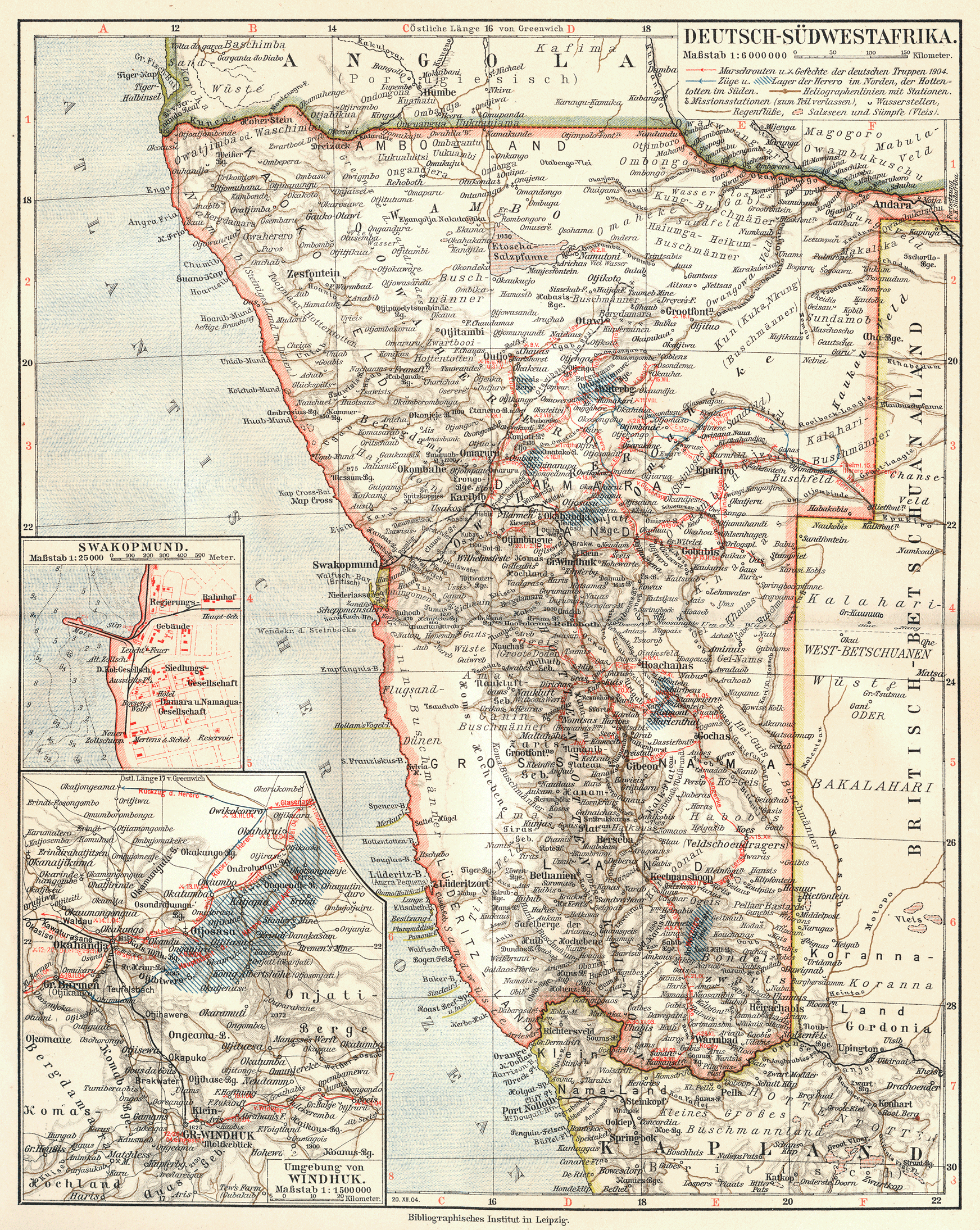
Enzian, in the novel’s Herero and Nama material, is the son of a Russian sailor and a Herero woman; his mother dies on Samuel Maharero’s great trek across the Kalahari after the 1904 uprising, drinking water too fast at a waterhole where no one warned the stragglers. The Ovatjimba find him as an infant. Some twenty years later, a German officer named Weissmann (who will reappear in the novel’s final section as Blicero) takes possession of him and eventually brings him to Europe. The Zone-Hereros, when they reappear in Part III as the Schwarzkommando, carry that history at the level of grammar. The word they whisper as a mantra, Enzian explains, is Mba-kayere. It means ‘I am passed over’; in the first instance, death passed over them, and they survived. Enzian himself rejects the ‘Will of God Theory’ and frames their survival in statistical terms (‘our own chances of being right here right now are only a little better than even’), but Pynchon’s English gloss carries the Calvinist resonance regardless: ‘passed over’ is the Latin praeteritus made audible.
What happened to the dodo and to the Herero happened again in Europe, and by then it had reached the makers of the Rocket itself. Beneath the Kohnstein massif near Nordhausen, prisoners from a Buchenwald subcamp converted two parallel tunnels into an underground V-2 production line; Mittelwerk GmbH belonged to Speer’s Armaments Ministry while the SS supplied and controlled the camp labour. Of the tunnels the narrator writes, in a phrase that reads like a factory manager’s dream: ‘The moving vehicle is frozen, in space, to become architecture, and timeless. It was never launched. It will never fall.’ The bulb, in Pynchon’s later tangent on Byron the Bulb, becomes ‘one of the great secret ikons of the Humility, the multitudes who are passed over by God and History’. Even the ikon is Calvinist.
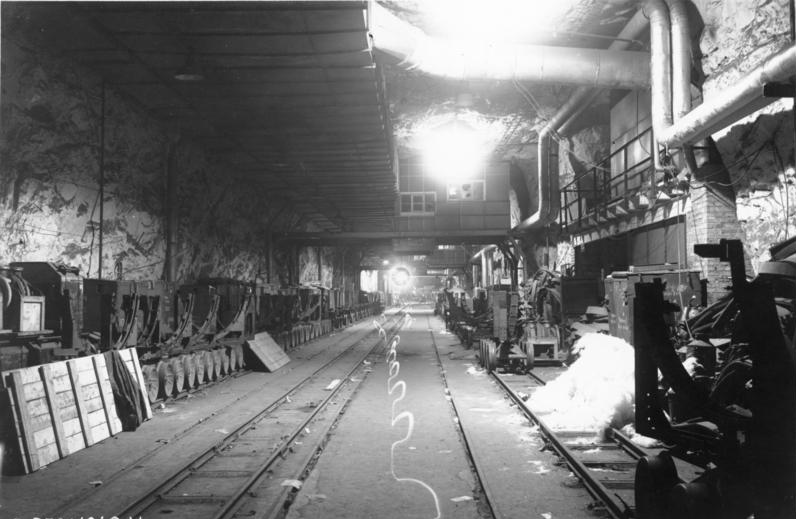

Franz Pökler, a fictional rocket engineer at Peenemünde, works inside that same factory system as the frighteningly usable man: competent, cause-and-effect, weak enough to be manipulated and decent enough to be damaged by the bargain. The narrator traces his knowing blindness: ‘with his guilt become a sensual thing, prickling at his eyes and membranes like an allergy, it would seem to Pökler that he could not, even by that day in Weissmann’s office, have been ignorant of the truth. That he had known the truth with his senses, but allowed all the evidence to be misfiled where it wouldn’t upset him… He had known too, all along, that Ilse was living in a re-education camp.’ The System does not require him to enjoy cruelty. It requires him to accept local frames: this contract, this material, this fairing, this visit, this year.
Ilse, Pökler’s daughter, turns that local obedience into an experiment in sparse data. His SS superior Weissmann arranges yearly visits to Zwölfkinder, a children’s resort some 280 kilometres from Peenemünde, if the girl is Ilse at all. The interval is too long for knowledge and too precious for rejection. Pynchon writes the analogy directly: ‘They have used it to create for him the moving image of a daughter, flashing him only these summertime frames of her, leaving it to him to build the illusion of a single child… what would the time scale matter, a 24th of a second or a year (no more, the engineer thought, than in a wind-tunnel, or an oscillograph whose turning drum you could speed or slow at will…)?’ The engineering mind that builds rockets out of discontinuous measurements is asked to build a daughter the same way. The phrase ‘Ilse, some Ilse’ names the cost of that interpolation. Pökler cannot verify the signal; refusing it would destroy the last structure by which he can still call himself a father. Recognition has been stripped of continuity, and love becomes an input.
The rocket’s guidance integrates acceleration into distance; the system around Pökler integrates absence into obedience. Pökler keeps working partly for Ilse, partly because of Ilse, partly because Ilse has become administratively inseparable from the work. Predestination breaches here into the interior life.
Pynchon uses ‘preterite’ across cases that never collapse to one single meaning: coal-tar in Rathenau’s séance, ‘the vast Humility’ Enzian invokes, the Herero survivors who whisper Mba-kayere, ‘passed over’ by the death that took the rest. Ilse is my extension of the word, not Pynchon’s: she is present as an object and denied as a continuous subject, administratively used as leverage over her father through yearly frames. What these cases share, once held together, is being passed over as a subject even when selected as an object: registered as labour, target, resource, stimulus, waste, or error, but never encountered on their own terms. And in the case of the Zone-Hereros the phrase carries a specific double: first, death passed them over in the genocidal campaign begun by von Trotha against their people in 1904, and then the postwar order passes over them again by forgetting that they exist at all. The word permits Pynchon to name that position without flattening the differences between the systems that produce it.
Towards the end of the book we see two numbered rockets, one for each side of the sorting. Weissmann’s 00000, the elect’s machine, will be fired from the Lüneburg Heath; the Schwarzkommando, on the preterite side, reassemble the unlaunched 00001 from parts salvaged and traded across the Zone. Enzian kneels to lift an iron tailgate on the truck carrying the disassembled 00001 and thinks: ‘Who will believe that in his heart he wants to belong to them out there, the vast Humility sleepless, dying, in pain tonight across the Zone? the preterite he loves, knowing he’s always to be a stranger…’ Inside the Erdschweinhöhle he is not the only political voice. Josef Ombindi of Hannover leads a faction called the Empty Ones, or Otukungurua, ‘Revolutionaries of the Zero’, who preach negative birth rate and racial suicide, arguing that the tribe should finish the extermination the Germans began in 1904. The 00001 centres Enzian’s hope for continuity, but it also gathers Ombindi’s opposing zero-politics into the same project; Enzian reaches a ‘strange rapprochement’ with him, and the Rocket, in the novel’s phrase, contains their argument without resolving it.
A ballistic system runs on values chosen before launch and, after Brennschluss, admits no further correction. The colonised return through the coloniser’s technology, yet the technology has been engineered inside the same imperial grammar. The question the 00001 poses, and that Ombindi’s Otukungurua answer differently, is whether the passed-over can seize the elect’s machine and use it to escape the sorting, or whether the machine’s logic is such that any use of it repeats what was done to them. Neither the novel nor Enzian settles this; the 00001’s actual launch is deferred past the last page. The elect who choose what gets stabilised and what diverges are not neutralised by a Herero assembling his own rocket.
Between Enzian’s project and Weissmann’s lies the Zone: occupied Germany between May and August 1945, the interregnum between the collapse of the Reich and the recrystallisation of the Cold War at Potsdam, a moment when the sorting apparatus has temporarily lost some of its ordinary coordinates. Squalidozzi, the Argentine anarchist Slothrop briefly meets, articulates the utopian case: ‘this War—this incredible War—just for the moment has wiped out the proliferation of little states that’s prevailed in Germany for a thousand years. Wiped it clean. Opened it… In the openness of the German Zone, our hope is limitless.’ Then, ‘as if struck on the forehead’: ‘So is our danger.’ Slothrop, drifting north with Squalidozzi’s anarchism still in his ear, arrives at the closest thing to a political programme the novel ever formulates: ‘maybe for a little while all the fences are down, one road as good as another, the whole space of the Zone cleared, depolarized, and somewhere inside the waste of it a single set of coordinates from which to proceed, without elect, without preterite, without even nationality to fuck it up’. I read those coordinates as the novel’s unreachable good: not a Preterite homeland but the abolition of the division itself, a starting point chosen by a subject, not a destination imposed on a target.
The Zone does not last, and Slothrop leaves it as a dispersal, thinning until he becomes ‘a crossroad, after a heavy rain he doesn’t recall’, standing under ‘a very thick rainbow here, a stout rainbow cock driven down out of pubic clouds into Earth, green wet valleyed Earth, and his chest fills and he stands crying, not a thing in his head, just feeling natural’. The rainbow belongs to a man who has stopped being an individual and become a place.
The preterite do not escape the sorting machine by dissolving; they simply become uncountable, and Squalidozzi’s opening is paved over once the Cold War fences go up in Slothrop’s wake. But the rainbow is the closest the novel comes to grace: an arc that need not be a coordinate or a guidance path, and need not carry a message.
Weissmann’s rocket does launch. At the northern firing site in the last days of the Reich, he has prepared the 00000, a modified V-2 carrying the Schwarzgerät with Gottfried sealed inside; the night before, he tells the boy: ‘In Africa, Asia, Amerindia, Oceania, Europe came and established its order of Analysis and Death… Now we are in the last phase. American Death has come to occupy Europe.’
‘Fathers are carriers of the virus of Death,’ Blicero says, ‘and sons are the infected.’ And later: ‘I want to break out—to leave this cycle of infection and death. I want to be taken in love: so taken that you and I, and death, and life, will be gathered, inseparable, into the radiance of what we would become.’ The Rocket, in Blicero’s private theology, is a way out of the terrestrial cycle. The ascent is the marriage. Gottfried, dressed in a white lace bridal costume and satin slippers, is sealed inside the Imipolex-lined shroud of the Schwarzgerät, Weber’s iron cage now machined to the dimensions of a single body. A tiny speaker, implanted separately, transmits Blicero’s last words into his ear; there is no return channel. His exact moment of death is unknowable, because the system has no means of registering it. The ritual completes what Weber’s iron cage began: a life fully rationalised into an input whose ending cannot even be confirmed.
The rocket ascends, and at Brennschluss the narrator tips into cosmology. A Brocken-spectre casts through Gottfried’s blond hair: ‘What is this death but a whitening, a carrying of whiteness to ultrawhite, what is it but bleaches, detergents, oxidizers, abrasives—’ and then Weissmann’s name unfolds through etymology: ‘Streckefuss he’s been today to the boy’s tormented muscles, but more appropriately is he Blicker, Bleicheröde, Bleacher, Blicero, extending, rarefying the Caucasian pallor to an abolition of pigment, of melanin, of spectrum, of separateness from shade to shade, it is so white that CATCH’. The whitening imagines a system so complete that nothing remains outside it, not even the passed-over.
Blicero’s last words, transmitted into Gottfried’s implanted speaker, sound almost like grace: ‘The edge of evening… the long curve of people all wishing on the first star… Always remember those men and women along the thousands of miles of land and sea. The true moment of shadow is the moment in which you see the point of light in the sky. The single point, and the Shadow that has just gathered you in its sweep…’ The elegy has the pity but not the innocence. Blicero is transmitting a beautiful sentence to the boy he is about to kill, into an ear whose voice can never talk back. The rocket, having reached its apex, turns over. Everything after this is fall.
And here Pynchon interrupts the fall. In the last two pages of Gravity’s Rainbow, the scene returns to an old Los Angeles cinema on Melrose Avenue whose night manager, Richard M. Zhlubb (‘friends and detractors alike think of him as “the Adenoid”’), is a scarcely-veiled Richard M. Nixon. The audience is watching a film. The film breaks or the projector bulb burns out; ‘It was difficult even for us, old fans who’ve always been at the movies (haven’t we?) to tell which before the darkness swept in.’ On the screen there is one last image: ‘It may have been a human figure, dreaming of an early evening in each great capital luminous enough to tell him he will never die, coming outside to wish on the first star. But it was not a star, it was falling, a bright angel of death.’ Then, formally: ‘And it is just here, just at this dark and silent frame, that the pointed tip of the Rocket, falling nearly a mile per second, absolutely and forever without sound, reaches its last unmeasurable gap above the roof of this old theatre, the last delta-t.’ The last delta-t, the infinitesimal interval before impact, is frozen in place forever. The novel places the 00000 over the last cinema in any town, over the reader’s chair.
Into this suspended moment Pynchon inserts a hymn attributed to William Slothrop, ‘centuries forgotten and out of print, sung to a simple and pleasant air of the period’:
There is a Hand to turn the time,
Though thy Glass today be run,
Till the Light that hath brought the Towers low
Find the last poor Pret’rite one . . .
Till the Riders sleep by ev’ry road,
All through our crippl’d Zone,
With a face on ev’ry mountainside,
And a Soul in ev’ry stone. . . .
Then, on the novel’s last line, the audience is asked to sing along, and the book breaks off: ‘Now everybody—’. Gottfried, sealed in the iron cage machined to his body, could hear Blicero and the ritual voices but had no channel back. The audience under the falling rocket has one, for the length of a hymn. The novel stops precisely where the audience’s answering voice would begin, and whether the elect and preterite can still be un-sorted by the sound of everyone singing together is left with the reader, mouth open, in the last delta-t before the blast.
Title from Part I, episode 14, in the Mauritius flashback: ‘Are they Elect, or are they Preterite, and doomed as dodoes?’
On the double integration in the V-2’s guidance, Niklas Riewald’s series on the math behind Gravity’s Rainbow. On Mittelbau-Dora, Michael J. Neufeld’s USHMM account. On the colonial material, the Natural History Museum’s account of the dodo and Britannica’s entry on the German-Herero conflict. On the Calvinist framework, John Calvin’s Institutes of the Christian Religion (Book III, chs. 21–24), Max Weber’s The Protestant Ethic and the Spirit of Capitalism (1904–05), and James M. Rankin’s ‘A New Election, A New Preterition’ (New England Quarterly, 2018). Steven Weisenburger’s A Gravity’s Rainbow Companion (Georgia, 1988/2006), of course, provides the indispensable annotation.