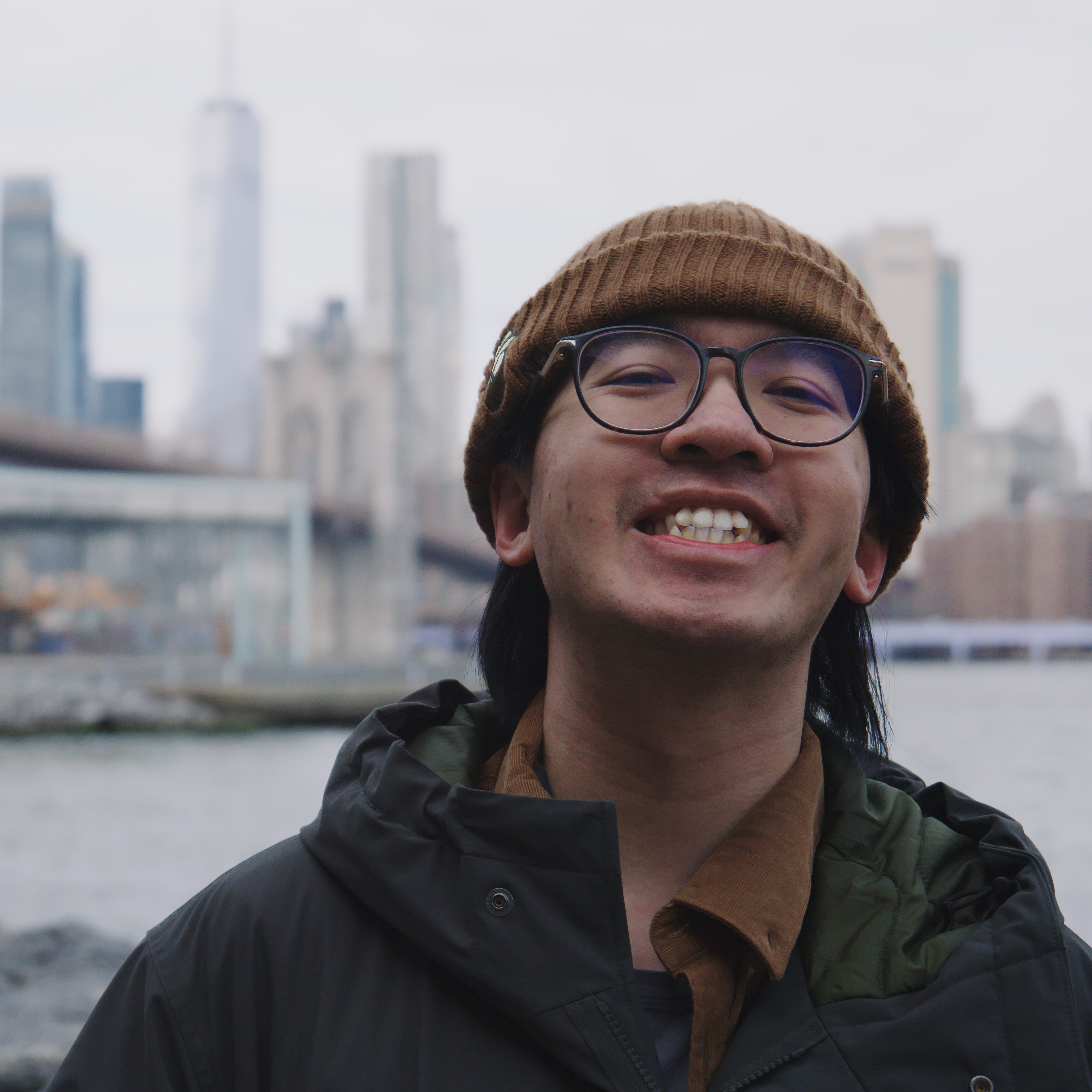
羅 丁豪
phd in neuroscience
data science
science journalism
phd in neuroscience
data science · sci. journalism
my thoughts on…
Taiwan Travelogue I wrote a full review (Who won the Booker? On transcreation and Taiwan Travelogue) on Lin King’s English translation of the book, which won the International Booker in 2026. These briefer thoughts below are dedicated to the original Chinese text. Yang Shuang-zi’s ambitious frame narrative sets Taiwan Travelogue to have been written in 1954 by the fictional Japanese novelist Aoyama Chizuko, whose first book was adapted into a film which brought her the opportunity to travel to colonial Taiwan. However, the ambitious frame immediately collapses the first moment a Chinese reader encounters the manga speech-bubble-style dialogue between Aoyama and her local translator, Chizuru. Aoyama, this supposedly celebrated author, speaks in exclamations like 「太厲害了!」 (which I almost could not help translate as ‘sugoi!’ instead of ‘so great!’ since it sounds so cartoonish and anachronistic) and vocalisations such as 「嗚嗯唔哼」 (which can only be approximated in English as ‘hmmm… hnnngh…’), with Chizuru who has ‘eyes curving into little arcs’ and offers ‘privilege tickets’ as a favour. And by chapter five Yang’s Aoyama has thrown grammar out of the window, with sentences whose participles do not agree with the subject at all (e.g. ‘As the Empire’s southern colony, and its first colony, I am interested in observing the crossed influences of the two places’ cultural styles during my time on the Island.’). All of this is the shōjo-manga cadence Yang Shuang-zi’s earlier career in yuri light fiction has employed, which in itself is certainly not a problem, but simply destroys any suspension of disbelief when the frame narrative puts the characters in 1930s Taiwan. Taiwan Travelogue names each of its chapter with various foods in colonial Taiwan and pre-war Japan, signposting their importance in the narrative. Sadly, the foods are described superficially and mostly bear no connection to the plot at all: we see a numbered sequence of cooking steps for most of these dishes, and the specifications (as they can only be called this) of such dishes fit what cookbooks and tourism brochures would print. Hilariously, the fictional-author frame was itself so unpersuasive that Spring Hill placed ‘Aoyama Chizuko’ in the author position on the first Taiwanese edition and Yang Shuang-zi in the translator slot. Readers later complained of deception until the third printing removed the false author line. The novel does, in various places, deliver its colonial thesis, though only as cursory thoughts rather than as scenes. The prologue by the fictional scholar Hiyoshi Sagako goes further, reading Aoyama’s chapter-IX ‘homage’ to Nishikawa Mitsuru (the leading Japanese colonial-literature writer in 1940s Taiwan) as indirectly ‘self-critique’ of her own earlier serialised Taiwan dispatches which later ‘became’ this book in our hands. These are the passages English-language critics (Eunice Lim in Suspect, Chialan Sharon Wang in Taiwan Lit) have quoted as the novel’s serious achievement in its otherwise yuri light-novel frame, and I tend to agree on these fronts. But most of the book is spent elsewhere, in the yuri cadence, where Aoyama presses Chizuru into wearing a kimono, telling her that she will look wonderful in it, and where Aoyama repeats her ‘friendship’ advances under the plain colonial power differential, despite recognising that the Empire’s southwards expansion is aggressive and brute. Yang does not once frame any of it as a problem, even in the afterwords which are supposed to offer reflection. Considering that Yang clearly understands the importance of this subject, the lack of serious discussion thereof seems more like a misplacement of priority. I found it a well-intentioned book, weirdly reminding me of another of my recent reads, Paul Auster’s Brooklyn Follies (2005), in that it wants to appear politically thoughtful but does not earn its mark. Obsession One would think, as ‘careful what you wish for’ has been literalised in film and fiction so many times that the phrase functions as a plot synopsis on its own, that there is nothing left to explore within the grasp of the monkey paws. But Curry Barker’s Obsession shows that the space is nowhere near exhausted. Baron Bailey (Michael Johnston), a music store employee, buys a novelty ‘One Wish Willow’ from a voodoo shop and wishes for his coworker Nikki Freeman (Inde Navarrette) to ‘love me more than anyone in the world’. Well, despite knowing roughly how this would play out, I was still shocked by the refreshing horror that Barker was able to render on the philosophical level, by how viscerally ‘brain-in-a-vat’ the parable eventually got. Partially thanks to the incredible performance by Inde Navarrette, and partially to how much Barker (confidently) trusts his audience, Ari Aster’s Hereditary (2018) was the first thing that came to mind as I walked out of the theatre: horror generated mostly by weirdness and eerieness, by relatable settings and dilemmas, by following an emotional logic to its endpoint, without much jump-scare scaffolding (all the ‘jump-scares’ in this feature are predictably preceded by sonic buildup which counter-intuitively made them scarier due to, possibly, Pavlovian conditioning of the audience). In contrast, Backrooms (Kane Parsons, 2026), which I reviewed a few weeks ago, offers the counter-example. Parsons had a spatial premise that amounted to horror on its own, then imposed a psychological reading on it that flattened the space; Barker starts from a psychological premise and lets the horror grow from working it out. I especially want to dwell a bit on the title ‘Obsession’: Baron’s wish is nothing like love, despite wishing for Nikki to ‘love’ him. His ‘Nikke should love me more than anyone else in the world’ places himself on the object position of the verb; his cowardice and indecisiveness are left unexamined, and he allows himself to push all the responsibility, all the proactiveness that is required of true ‘love’, onto Nikki. Everything the film does with this premise (and I don’t want to risk spoiling the fantastic horror by describing the specifics) follows from the fact that Baron has requested something with the shape of love but not the substance, mostly because he himself has no idea what love is. When one late scene forces Bear to confront his selfish, actual wish (Is it ‘obsession’, as the film’s title suggests, or ‘love’?), his line, roughly, is ‘is being with me really that bad?’ Well, yes, Baron. By the end of the film he would come to the same conclusion as us the audience, but then it would have been too late. On one last note about the budget, since it’s been a hot topic ever since the film’s release: Barker’s masterpiece could not have succeeded without Inde Navarrette, who is doing several characters’ worth of work in this film. The film grossed over $400 million on a $750,000 budget, a Focus Features record. Multiple outlets, including BroBible citing Supriya Ganesh of The Pitt on the record, have reported that Navarrette was paid a flat $20,000 for the role with no back-end participation; Navarrette has neither confirmed nor denied the figure. If accurate, the responsibility lies with Focus Features. A first-time theatrical director working with $750,000 has little to offer up front; the studio, once the film began earning nine figures, should have arranged retroactive back-end compensation. I hope, in the worst case that Focus does not do what is right, that Navarrette’s glorious performance opens the doors that it should for her. Lake Mungo On the dry lakebed at Lake Mungo, Alice Palmer (a name that definitely was a nod to Twin Peaks) accidentally saw her own drowned body through her phone’s camera lens: a standing figure with one eye shut, face pale, immediately recognisable as herself. She buried the phone at the site after the encounter and said nothing after returning home from the Lake Mungo school trip. Joel Anderson (whose only film was Lake Mungo) assembled this mockumentary from what the family finds afterwards: home videos, photographs, the parapsychologist’s transcripts, everything held in perfect posteriority, with guilt and pain unbeknownst to them yet on the day Alice died. Mathew Palmer’s ghost photographs turn out to be fabrications; the parapsychologist’s sessions yield nothing conclusive; by the time the family has worked through both, they have concluded there is no ‘haunting’. Alice had been in the home videos all along, at the edges of frames from evenings that had seemed ordinary, present in footage they had already watched without scrutinising, and the retroactive discovery shows that those exact evenings she was indeed standing at the frame’s edge while they were filming something else. It’s hard to look at the emotional core of Lake Mungo and not think of some recent found-footage films that made a lot more (Lake Mungo was a box-office disaster at under $30,000 with a 1.4-million-dollar budget) money: Strange Harvest and the Backrooms are found-footage films in which the grainy texture, the degraded image, and the form that the film takes are ends in themselves. In Lake Mungo the footage fills the gap between the emotional touches, and the form serves the function, where it’s clear that Anderson knew that he just had to make a found-footage mockumentary and there was no other way to tell this story. In Ray Kemeny’s office, when asked ‘Are you scared of dying?’ Alice said: ‘Of course, isn’t everyone scared of dying?’ She turns her fear into a rhetorical universal, unanswerable by definition; Alice probably does not want it answered, either. Was she scared in her last few weeks? What was she thinking over the long days until death? She had filmed her own corpse on a dry lakebed, buried the evidence, and when a psychic gave her an opening, she closed it with ‘of course’. The film gives the family no more than this; neither do we come away with more, having watched the same footage they watched. The Souvenir Julie (Honor Swinton Byrne), a film student in 1984, is living in a Knightsbridge flat when Anthony (Tom Burke), a self-described Foreign Office employee, moves in and stays. He is also a heroin addict who cannot stop lying, even inside what is otherwise a sincere relationship. Joanna Hogg, restaging her own affair from the same decade, rebuilds the Knightsbridge flat down to possessions she has kept for thirty years, casts Tilda Swinton as her mother Rosalind, and casts Swinton’s daughter Honor as the young version of herself. In the BOMB interview that accompanied the film, Hogg calls Julie ‘obviously a version of myself’, describes her writing method as ‘almost like a work of archeology’, and returns repeatedly to the word ‘processing’. The words ‘responsibility’ and ‘complicity’ never appear. She places herself in the position of one still coming out of a shadow, not one who might have contributed to it. Whether from naïveté or class-inflected habit, Julie never lets herself see Anthony clearly, and Hogg films that not-seeing with the tragic weight of a first love. Rosalind sees Anthony completely, does not name what she sees, and instead keeps writing cheques: covering the rent, covering the film school shortfalls, covering whatever amount is needed to keep Julie’s independence looking intact. The cheque-writing recurs across the film and each recurrence tells the same thing. Julie’s ability to remain, inside this relationship, the innocent and betrayed party depends on a middle-class safety net that never once actually retracts. And yet Anthony stays the film’s centre, romanticised into a kind of sculpture, while the net stays visible without ever being critiqued. Hogg shows the mechanism at length and never questions it. After Anthony dies of an overdose at the Wallace Collection, in a public toilet next to the gallery where he had first shown her the Fragonard, the film ends with Julie mourning as the wronged party. Yes, Anthony was the one lying, but Julie was also the one whose mother’s cheques allowed her to keep not looking, and this is the responsibility Hogg has still not touched. The Souvenir Part II If the first film is about how a class safety net lets Julie keep her blindness intact, The Souvenir Part II is about what that blindness costs everyone else. Hogg gives herself a convenient frame: Anthony has died, Julie will process the loss by making her graduation film about him, and the process itself will constitute Julie ‘finding her voice’. When Julie pitches the project to the graduate committee she uses Anthony’s own line back to them: ‘I want to show life as I imagine it’, the same phrase he had spoken to her in the first film. Inside an environment that protects her from every direction, using the words of a drug addict who could not stop lying, Julie makes a self-therapeutic film and calls the result her own voice. What a piece of self-congratulation. The same uncritical self-focus runs the rest of the film. Yes, a panel of middle-aged white male academics rejects Julie’s graduation proposal, but she can ring her mother, ask for £10,000, and requisition her classmates’ credits and future careers to work through a relationship none of them ever understood. The rejection-then-mother sequence is the moment where Hogg could have turned the camera hardest on her own class position: a woman filmmaker blocked at the institutional door, walking around it with family money. Instead she films it as a triumph. Rosalind’s £10,000 is not framed as irony but as solution; the committee’s rejection is not the reality Julie has to sit with but an obstacle to be routed around. Katherine Connell, in Cinema Scope, reads this generously, arguing that Hogg ‘cannily shows how her class background enables her to circumvent such institutional barriers’. But cannily showing is not cannily critiquing, and the gap between the two is exactly the step Hogg refuses to take. Pipistrello and the Cursed Yoyo Pocket Trap calls Pipistrello and the Cursed Yoyo a ‘yoyovania’, but the game it most resembles is a budget Super Mario Odyssey: the controls feel good, the exploration offers genuine surprises (the SlimeCorp level’s design, where you teach yourself the wall dash through spatial arrangement alone, is excellent), but the emotion and narrative cannot sustain ten-plus hours. Odyssey needs no narrative because the action itself has enough depth; Pipi’s yoyo is clever, but it does not reach that depth. Last year’s Öoo (Nama Takahashi, 2025) similarly relied on emergent teaching to let the player learn through play, but Öoo understood itself as a five-hour precision knowledge-lock, not a twelve-hour sprawl. Pipi insists on being the latter. The SlimeCorp levels deserve a separate note. A fracking-adjacent capital industry destroying the environment; four criminal capitalists each controlling a quarter of the city: the satirical scaffolding has genuine critical potential, a social fable waiting to be fleshed out. None of it is. The game touches each thread and moves on, and by the end only the puzzle skeleton remains. Worth playing; one only wishes the studio had known where to put its ambition. Close-Up I did not know, watching Close-Up for the first time, that any of it was documentary. The courtroom scenes, the family interviews, the man on trial answering the judge’s questions and calling himself Hossein Sabzian, all of it I took as a drama portrayed by professional actors, and it was only afterwards that I found out that the trial was real, Sabzian was Sabzian, captured by Kiarostami who had persuaded a Tehran judge to allow cameras in the courtroom. Sabzian tells the judge, on camera, at length, that pretending to be Makhmalbaf made him feel like a real filmmaker. I, for one, did not doubt that he loved cinema outside the courtroom, but I really couldn’t tell whether his testimony in court, where performance becomes a requirement for sympathy, was true or performed. Then there is the ending, which I still find hard to summarise. Sabzian is released from prison and met at the gate by the real Mohsen Makhmalbaf; Makhmalbaf rides him across Tehran on a motorcycle towards the Ahankhah house, and the audio cuts out repeatedly through the ride. Kiarostami claimed the wireless microphone had malfunctioned. Godfrey Cheshire established, years later, that at least some of the dropout was engineered in post-production. So the film ends with Kiarostami faking a documentary accident to withhold the sound of an event that actually happened. Here, again, we find ourselves at the crossroad of reality and documentary. Kiarostami had every reason to hand us the emotional payoff: the real Makhmalbaf’s first words to the man who had been pretending to be him, said inside a moment neither of them could have staged, would have been the film’s obvious climax. But Kiarostami probably realises that by the end of the trial the audience would have started to want a verdict on Sabzian, either ‘genuine cinephile’ or ‘manipulator who performed the plea in court’. Letting Makhmalbaf’s real words through would have supplied whichever piece of evidence the audience needed to settle it, and Kiarostami would rather leave his own film with a hole in it. Whether Close-Up is better or worse for it I cannot say, but it sure adds a unique taste to the famous motorcycle scene. It’s hard to talk about Kiarostami without mentioning Panahi, who was one of Kiarostami’s long-term assistants. One would expect Panahi to have learned Kiarostami’s way of pointing a camera at the seam between the real and the staged, and for a while he probably did as his mentor had done. However, looking at his recent No Bears (2022) and It Was Just an Accident (2025), I keep finding that he has replaced Kiarostami’s ambiguity with elaborate scenes about ambiguity. Kiarostami left a camera running in a courtroom. Panahi, in contrast, stages courtrooms. Somewhere along the way, the essence of what his teacher was doing has been lost. Unlike Kiarostami’s attempt to fake microphone drop-offs for a narrative purpose, this, I would say, has certainly left Panahi’s films worse off. The Sense of an Ending It’s hard to read The Sense of an Ending without thinking about the science of memory reconsolidation: every retrieval destabilises the stored trace and re-encodes it, so what returns to storage is not the original but a version shaped by the self doing the recall. Tony Webster has been re-recording his 1960s schooldays, his Bristol relationship with Veronica Ford, Adrian Finn’s suicide, for forty years. The Tony who narrates Part One believes he was broadly reasonable, broadly hurt, never unjustified, never cruel; he remembers his letter to Adrian, written when Adrian began dating Veronica, as ‘brief, anodyne’. And when we the readers see Veronica return the actual letter in Part Two, it is sexually vicious, calls her a cockteaser, wishes pregnancy on her, instructs Adrian to ‘consult the mother’. Each recall has rewritten the trace cycle by cycle into something compatible with the peaceable man Tony needs himself to be. Barnes dramatises the process without naming the science. Every review of this book, including this one, ends up supplying the citation he withheld. Barnes later wrote in the Guardian that the title was not, contrary to popular belief, borrowed deliberately from Sir Frank Kermode’s 1967 The Sense of an Ending: Studies in the Theory of Fiction: he ‘had not heard of Kermode’s book, let alone read it’. If that’s the case, then it is one of the most beautiful coincidences that Kermode’s book does offer a valuable insight into Barnes’ novel: Kermode argued that we make time bearable by converting chronos into kairos; that is, converting formless duration of time into key narrative moments (and it is by another wondrous coincidence that I myself happened to be working on a project named Kairos when I read Barnes’ book). Barnes’ narrator carved, from that formless duration, stories and justifications that may have never existed: Adrian is the brilliant friend who chose philosophy over life, Veronica the difficult ex that probably never loved him, himself the moderate observer. Barnes implicates the reader along the same line. We have been reading Tony’s re-encoded version as if it were the original recording, sharing (I certainly did as I read Part One) his irritation at Veronica’s withholding; the withholding turns out to be the only adequate response to a man whose English reasonableness has been doing the editing for him. Tony, even in the final pages of the novel, remains inside the loop, still re-encoding, and Barnes never grants him the moment of clear recognition the genre would normally supply. The novel, despite being clearly not of the mystery genre, never resolves. Backrooms Kane Parsons was seventeen when he uploaded the first short ‘Backrooms’ videos onto YouTube, and the videos had what Mark Fisher would call the weird and the eerie in concentrated form: lamps humming over carpet that extends to the horizon, spatial geometry without any sense of consistency, rooms whose purpose is legible (office, corridor, stairwell) but whose reason is not. The horror in those videos lay entirely in the gap between function and presence; one could recognise what a room was for without being able to say why it was there. We carry generalised schema-based memories as heuristics for defining the world: we recognise instantiations of such schemata, and Parsons’ early YouTube videos broke these schemata with such a force that the resulting confusion amounts to cosmic horror almost spontaneously. Backrooms sustains this ‘cosmicness’ for its first act: Clark (Chiwetel Ejiofor) steps through the furniture store basement wall into consecutive rooms, each styled differently, each familiar in isolation and collectively impossible, each haunted by that-which-shall-not-be-named in a Lovecraftian sense. For the opening forty minutes, horror pervades with the same spontaneity as Parsons’ early YouTube videos, and nothing concrete needs to happen inside those impossible spaces (bar the occasional scare provided by the silhouetted creature, seemingly hostile but never directly presented as such). The turn comes when Clark starts bringing other people in: the rope sequence, where his employee Kat and her boyfriend Bobby are tethered and sent into the labyrinth, is the film’s best scare precisely because we still cannot see what takes Bobby, only hear the line go taut and snap. Unfortunately after that, the film begins committing to answers it cannot afford. The film lost me entirely when the silhouetted creature eventually emerges in full: ‘Pirate Clark’, an unhumanly tall distortion of Clark’s own furniture-store mascot, the pirate costume from his budget television ads grotesquely scaled up and given a body. The Backrooms, it turns out, copy what one brings into them in a manner reminiscent of certain SCP entries, and what Clark brought was himself. The schemata-breaking logic of the first act collapses into something legible, answerable, therapeutic: a man confronting a literalised version of his self-loathing. What had been a question about space becomes a question about character, and character is answerable in a way that broken spatial geometry is not; the horror, the moment it acquires a face and a psychological explanation, ceases to be horror at all. It is the same trajectory the Alien franchise traced over four decades (from Ridley Scott’s half-seen jaw in 1979 to the biological close-ups of last year’s grandest disappointment Alien: Earth), except Parsons managed to ruin his own ‘Alien’ in a single film rather than four decades of sequels. Treme Season 1 Where The Wire built its case against institutions by examining the machinery of their failure, Treme attempts something David Simon had never attempted: it watches people live. Three months after Katrina, the city is broken in ways the show actively refuses to dramatise; instead the damage is environmental, sedimented into NOLA’s denizens’ daily life. For example, we see water stains sit at shoulder height on barroom walls, where the Amerindian Big Chief Albert Lambreaux (Clarke Peters) holds practice in the same cramped room where his tribe sews their Mardi Gras suits, because the hall they used before the storm is gone. Simon’s method in Treme is accumulation, a lot more of it than in The Wire: Antoine Batiste (Wendell Pierce) hustles trombone gigs that pay a hundred dollars and borrows instruments because his own was lost in the flood; Janette Desautel (Kim Dickens) cooks with whatever her suppliers still carry, running a restaurant on credit and stubbornness; Albert tracks down scattered tribe members one by one, because the suit means nothing without the people who walk beside it. Everybody is trying to ‘save’ NOLA, one crawfish etouffee and one rehearsal and one parade at a time. Antoine’s world is brass band and second-line parade music, the working musician’s circuit of clubs and funerals and festivals where you play for four hours and split the fee six ways. Albert’s is Mardi Gras Amerindian chant: call-and-response passed down through oral tradition, rehearsed in living rooms with tambourines and cowbells, performed in full regalia on the three or four days a year when the suits come out. His son Delmond (Rob Brown) plays modern jazz trumpet in New York and loathes coming home, because New Orleans jazz feels to him like a museum piece rather than a living practice. I share that instinct towards modern jazz, but I went to Preservation Hall recently and found the old-school sets surprisingly virtuosic and charming; Delmond’s nine episodes of refusal read to me as wilful deafness, and the show seems to think so too. There is no score in the conventional sense; every piece of music is diegetic, someone always playing it, in a room, on a street, for money or for love or because their mother told them to take the horn outside. In episode 8, ‘All on a Mardi Gras Day’, the first post-Katrina Mardi Gras, all of these registers sound at once. Janette is out in the rain working a mobile grill because her restaurant has gone bankrupt; Antoine is blowing through yet another gig, bored, brilliant, underpaid; Delmond is on stage playing modern jazz in a proper concert setting, still holding himself apart from the city his father is fighting to reassemble; Albert cannot mask with his tribe because the police who beat him in episode 7 have ensured his court date lands on the one day that matters. Everyone is trying to live at the same time, in different musical registers. Creighton Bernette (John Goodman), a big-hearted literature professor, enters the show by throwing a British TV crew’s microphone into the river in the pilot episode. That clip goes viral (by whatever standard of ‘viral’ was back in the days). By episode 4 his YouTube rants against federal negligence have made him a local celebrity: his anger looks like energy, like commitment. He is also writing a novel about the Great Mississippi Flood of 1927 but never progresses past a blank screen and deleted sentences. The anger sustains him until it doesn’t. In episode 9 he assigns Kate Chopin’s The Awakening to his students, tells them the protagonist’s drowning ‘was not the end, just a transition’, then boards the Algiers Ferry and steps off the railing into the Mississippi. Everyone else in Treme cooks, practises, sews, plays, walks the parade route; meanwhile Creighton performed caring so loudly that nobody, including himself, noticed the performance had replaced the thing itself. The Trial K. is arrested on the morning of his thirtieth birthday and executed on his last day of being thirty: nearly a full year, during which the Court neither imprisons him, nor requires his attendance. But the Court waits and sprawls, spreading into every aspect of K.’s life. And K., who could have walked away at any point, who should know the proceedings have no binding force unless he grants them one, unfortunately chooses to submit. He adjusts his Sunday schedule around the hearing times. He prepares his defence. He even goes actively looking for the Court in attics and tenements and (unsurprisingly) finds it everywhere, because by looking he has already conceded its jurisdiction. The System’s invasion is gradual and total: Court personnel appear in his bank, his lodgings, on street corners; the architecture of daily life reveals itself to have been the Court’s architecture all along, merely unnoticed until K. began paying the kind of attention that constitutes submission. As a universally acknowledged fact it is impossible for a review of The Trial not to mention Kafka’s most famous parable: ‘Before the Law’ talks about a man who sits before an open door for his entire life, waiting for permission to enter, and dies without entering. Before he dies, the doorkeeper finally tells him that the door was meant only for him and is now being shut. The man’s deference to the System is the door’s only lock; again, even in this little parable we see that control relies on submission. And K. almost recognises this; the conversation with the chaplain is the closest that he comes to seeing that the Court’s authority is produced by the defendant’s belief in it, that his own compliance is the engine of his prosecution. He sees it and, being far too late, cannot act on what he sees anymore: he has already internalised the Court’s frame so thoroughly that even recognising the absurdity does not release him from it. He walks to his execution like a dog, and the shame, Kafka writes, will outlive him. As Breon Mitchell notes in his translation preface, Kafka died before settling the chapter order; Mitchell’s translation preserves crossed-out passages and variant wordings in an appendix, so we read the novel knowing it has no authoritative sequence. The effect is that K.’s year feels unfinished in the same way his defence is unfinished: there is no moment where the Court announces a verdict, no scene that closes the case. The execution arrives mid-sentence, mid-life, as casually and comically as the arrest did. And one suspects Kafka’s point is simpler and worse: the shame K. feels as he dies, the shame Kafka says will outlive him, does not require a conclusion. It only requires that enough people, like K., keep showing up to hearings they were never compelled to attend. The System functions by threats and intimidation. I fear that we already know this but simply do not act. My Father's Shadow On 12 June 1993, the day of Nigeria’s presidential election, Akin and Remi (played by the real-life brothers Godwin and Chibuike Marvellous Egbo) are taken by their long-absent father Folarin (Sope Dirisu) across Lagos. The boys do not know what day it is. The Davies brothers, in My Father’s Shadow, decide to put the kids’ not-knowing front and centre, and see those chaotic times through the kids’ lens. The camera stays at the height of their gaze. Folarin’s six months of unpaid wages, his affair, his recurring nosebleeds, the military checkpoint where a soldier seems to recognise him as someone who was somewhere he should not have been: all of these arrive as moments the boys merely observe, with the camera observing with them. The result is a deceptive ‘narrative thinness’, but I do think that the thinness is the point. The Davies brothers built a film whose narration cannot exceed its observers’ horizons, thus diluting, constraining, but (strangely) also amplifying the political weight of the day. Politics enters the kids’ view as fragments. They glimpse newspaper headlines at a kiosk, hear voices at a café arguing over Abiola and Babangida, see military trucks at the edge of a frame, sense the gates of the notorious ‘Bonny Camp’ drifting past the bus window. None of these are explained to us the audience, but we understand them as the kids do, as they accumulate into an overwhelming background voice. We dissolve, as the kids do, into this voice, into the eyes of the people under brutal rules, into the tears of those whose friends, families, colleagues perish. The ‘big reveal’ comes in the final act, where at a café, the boys are eating, and the television announces what is happening: Babangida’s military government has annulled the election. We see people rise from their tables; the streets begin to move; the fragments the boys have been brushing past all afternoon resolve into the single event of which they have been but ambient signs all along. The film cuts forward from there to Folarin’s funeral… Something happened in Lagos that day, and the boys’ father did not come home. And yes, Akinola and Wale Davies lost their own father very young; on some level, the film reconstructs what the Davies brothers could not remember. Now, Moshood Kashimawo Olawale Abiola, the man whose democratic victory was annulled by Babangida on television that afternoon, had won what is still widely held to be the freest and fairest election in Nigerian history. He died in detention five years later. The boys, of course, would not have known any of this yet. Stiller Freund Enyedi braids three timelines together, all intersecting at a ginkgo tree in Marburg, and the tree gives the film its question: how curiosity makes empathy possible across boundaries. There is a neurologist stranded during COVID (Tony Leung) who pivots from brain research to scanning the tree’s electrical activity (and obviously I have deep gripes about the pseudo-science presented here, but that’s beside the point); a solitary student in 1972 (Enzo Brumm) who inherits his roommate’s geranium and slowly befriends it; and a German university’s first female student in 1908 (Luna Wedler) fighting institutional exclusion while discovering photography. The three plotlines converge on communication: across species, across eras, across the gendered and linguistic chasms humans keep building around themselves. Brumm and Wedler play curiosity as a bodily process: Hannes goes from knowing nothing about plants to rigging a sensor so the geranium can open the residence gate when it ‘hears’ voices (probably by sensing mechanical vibrations at certain frequencies); by the end he treats the plant as a companion whose displeasure he takes seriously. The progression is comic and sincere, capturing, eerily, how scientific curiosity operates: one probes, connects, tries to understand, and in doing so dissolves a boundary one did not know was arbitrary. Leung and Seydoux, by contrast, fail to convey that curiosity in any way more interesting than pseudo-scientific ‘neuroscience’ gimmicks; this is not the actors’ fault, but their characters are vehicles for the film’s thesis without undergoing the transformation that would make the thesis convincing. Grete’s timeline (shot in black-and-white 35mm, Wedler earning the Mastroianni at Venice) is beautiful in isolation but never overlaps thematically with the other two stories; one admires the craft without feeling the resonance. Lovely sentences are scattered through the film, about plants existing on timescales that dwarf human attention, about the boundaries of perception being choices rather than facts; they arise naturally, but do not accumulate into an argument. They remain ‘aperçus’, individually sharp, collectively scattered. I liked Stiller Freund; still, what a pity. The Brooklyn Follies Auster’s prose remains a pleasure to read: the sentences are warm, the coincidences (as I wrote in my review of The New York Trilogy [1987]) land with their usual offhand grace, and Nathan Glass’s voice carries the melancholy of a man who has (indeed) come to Brooklyn to die quietly and instead finds himself drawn back into life. But The Brooklyn Follies is a book that wants credit for its politics without earning them. It advocates ‘voting Democrat’, ‘protecting the little guy’, and embraces some of its characters’ queerness with what it clearly considers generosity, almost as if Auster wrote the last few chapters of the book whilst constantly patting himself on the back. And yet if one just squints slightly, they would see that every woman in the novel exists as a surface: Marina is beautiful and available; Rachel is shrill and estranged; Joyce is a body Nathan admires from across a room. They are described from the outside, assessed for attractiveness, and then set aside once the men have extracted what they need from the interaction. The progressive posture makes this worse, not better. A book that signals its enlightenment on every other axis while writing women as though it were still 1955 is dishonest at best. I noted the same problem in Moon Palace (1989) and found that it had grown to an unforgivable extent in Invisible (2009), which would fail the Bechdel Test with flying colours. The Brooklyn Follies sits between them chronologically and morally: the sexism is less grotesque than in Invisible, but the gap between the book’s self-image and its actual gender politics is wider, because here Auster is actively performing progressivism while reproducing the same flat, male-gaze portraiture that he has never interrogated. What a waste of his wonderful prose. It was not until 4 3 2 1 (2017), more than a decade later, that one could detect any movement away from such bigotry at all. But that would prove too little, and literally, too late. Mixtape Mixtape has my favourite intro of any game this year, and throughout the 4-hour-ish playthrough the art direction sustains its promise: Blue Moon Lagoon is gorgeous, the stop-motion-inflected animation is confident, and the vibe of a final high-school night carries genuine warmth. What it cannot sustain, however, is the game around it. The narrative asks the player to inhabit Stacey Rockford’s last evening with her friends, but Stacey and her companions are so thinly drawn that this inhabitation never occurs; one watches them from outside, waiting for interiority that never arrives. The gameplay vignettes (skateboarding, sweeping leaves, exploring an abandoned dinosaur park) are similarly weightless. I know ‘playability’ is a contested value in narrative games, that some consider it irrelevant, but in a game that attempts to build its whole structure around immersion, I think playability is of critical import. Something has to hold the player inside the experience, and here nothing does. The deeper failure is the mixtape conceit. Stacey (and once her companion ‘Slater’) introduces each track with fourth-wall narration, which should create the sense of personal curation, of songs chosen because they mean something to her at this particular moment. It does not. The licensed catalogue is enviable (Joy Division, Iggy Pop, Siouxsie and the Banshees, Alice Coltrane) but the tracks float free of the scenes they accompany; songs play, vignettes unfold, and the two exist in total parallel. The studio captured the form of late-eighties mixtape culture (the aesthetic, the era, the physical object) while forgetting the personal logic of selection that makes a mixtape more than a playlist. The one moment that approaches genuine curation is Alice Coltrane’s ‘Galaxy in Turiya’, placed on a mixtape that ‘Lover Boy’ makes for Stacey and scored to an animated kiss: a song chosen for someone, with feeling and a bit of pretentiousness from ‘Lover Boy’ behind the choice. Even this grand gesture of love passes as mere transition. I simply cannot detect any love for mixtape culture here, in a game titled Mixtape. I only see familiarity with the surfaces of this bygone era. In the tradition of youth narrative, the studio clearly wants to be the next DONTNOD. The distance is considerable. The Wire Season 5 David Simon spent thirteen years as a reporter at the Baltimore Sun. He left in 1995, and then spent another thirteen years telling Baltimore’s story without them. By the time The Wire turns its camera on the newsroom, the institution that was supposed to watch all the others has lost sight of itself. The fictional Sun journalist Scott Templeton fabricates a quote from a homeless man, then a phone call from a serial killer who does not exist, then a veteran’s combat story. His editors do not investigate. They need the narrative, need the Pulitzer, need the evidence that their institution still matters. The System rewards what preserves it; it discards what questions it. Žižek, in The Year of Dreaming Dangerously (2012), mapped the show’s cumulative architecture: each season peels back one institutional layer, from the drug war to the working class to policing to education, and Season 5 arrives at the media. Simon said that The Wire is a Greek tragedy in which the postmodern institutions are the Olympian gods. In the final chapter, the show enters its last temple and finds it as empty as the rest. The same mechanism that destroyed Colvin in Season 3, that drowned Sobotka in Season 2, operates in the Sun’s newsroom with the same indifference. Every institution has been hollowed out; the one designed to expose the hollowing was hollowed first. The police department is the temple Simon knows best, and in Season 5 it produces his most devastating irony. McNulty spent four seasons as the show’s investigative conscience: the detective who forced cases into existence over the chain of command, who saw the drug war as a systemic failure and could not stop naming it. Carcetti’s gubernatorial campaign has now starved the police budget; the reformer who entered office in Season 4 has completed his accommodation to the System, and the Stanfield investigation is shut down for lack of funds. McNulty’s response is to become what he spent five seasons hating. He fabricates a serial killer targeting homeless men, staging crime scenes to generate press attention and the departmental funding that follows it. Lester Freamon joins him: together they use the fabricated case’s budget to fund an illegal wiretap on Marlo Stanfield’s untraceable communication system. The wiretap works. The evidence is real. And every piece of it is built on a lie. The show’s cruelest argument is that the two best detectives in Baltimore can only pursue justice by first committing a fraud; the System forces their corruption as the price of functioning within it. The structural parallel with Templeton completes the irony: the cop fabricates a crime that the reporter fabricates coverage of, and the institution that should expose the one cannot, because it cannot see itself. Kima Greggs is the one who breaks the silence, because she cannot live inside the lie, and this act of integrity triggers precisely what it must: Carcetti orders a cover-up. The System does not punish corruption. It punishes visibility. McNulty’s fabrication does produce enough evidence to bring down Stanfield’s organisation, but the irony completes itself: because the wiretap rests on a lie, Marlo walks free. The institutions have concluded their business. The street has not. Omar Little returns from exile to avenge Butchie’s murder, walking with a limp from a shattered leg that never healed: the game’s debt written on his body. He robs and terrorises Marlo’s people, and the myth precedes him as it always has. In the eighth episode, he walks into a Korean corner store to buy a pack of cigarettes. Kenard, a child of perhaps twelve, follows him inside and shoots him in the side of the head. There is no music. There is no slow motion. There is no reckoning. In Season 3, neighbourhood children play-acted a shootout, arguing over who got to ‘be Omar’; the child who insisted it was his turn was Kenard. The boy who mythologised Omar is the one who demythologises him. The Sun does not report the death, because there is no room in the paper. The show’s most legendary figure exits as what he always was beneath the myth: a body, processed by a system that does not distinguish between legends and statistics. The final episode is titled ‘-30-‘, the journalism term for end of transmission, and what it transmits is a city that has metabolised sixty-six hours of human effort and returned to its resting state. Michael Lee robs a stash house with a shotgun, beat for beat recreating Omar’s first appearance in Season 1. Sydnor visits Judge Phelan to force a case over the chain of command, exactly as McNulty did in the pilot. Marlo, introduced to property developers at an evening reception, cannot inhabit the room; he slips out to the corner, provokes a fight with boys who do not know his name, and stands there bleeding, alive in the only place that will have him. And Dukie, the gentle boy whom Prez tried to save in Season 4, shoots heroin with the junk man. His last scene is a visit to Prez: he asks for money, claiming it is for a GED programme, and Prez hands it over, knowing what it is for, and watches in the rearview mirror as Dukie walks back towards the encampment. One sees clearly, at a distance, and cannot reach. The roles are structural. The game simply recasts. Against all of this, Bubbles climbs a flight of stairs. He has spent the season in his sister’s basement, sober but exiled: she will not let him upstairs, does not trust him near her daughter. He cannot speak honestly at NA meetings about Sherrod, the teenager he accidentally killed in Season 4. In the finale, Bubbles stands before the group and confesses what he did. His sister, reading the Sun’s profile of him, the paper’s one act of genuine journalism in a season of fabrications, unlocks the basement door and calls him up. The last image of Bubbles is him sitting at the dinner table with his sister and her child. In a show that has spent sixty-six hours demonstrating that no individual can reform the System, Bubbles reforms himself. He tells the truth about what he did, and someone who loves him opens a door. The institutions that failed him for decades play no part in his recovery; Dukie descends as Bubbles ascends, and the System notices neither. Perhaps this is what The Wire has been saying beneath the Greek tragedy and the institutional architecture: that the System will not save anyone, that it was never designed to, and that the only redemption it cannot destroy is the one too small for it to see. Simon called The Wire a Greek tragedy. I guess it really is, David. And the gods always win. عنکبوت مقدس Abbasi has said he wanted to make not a serial killer film but a film about a serial killer society, and Holy Spider is at its most convincing when it follows that approach. Saeed Hanaei (Mehdi Bajestani) murders sixteen sex workers in Mashhad, and Abbasi locates the killings inside an institutional architecture: police who will not file missing-persons reports, a courtroom that tilts towards the defence, a public that gathers outside in solidarity with the killer. The city does not merely fail to stop the murders; it cannot bring itself to call them wrong. This is, I think, the ‘serial killer society’ that Abbasi is trying to capture. Rahimi (Zar Amir Ebrahimi, who won Best Actress at Cannes), the journalist that Abbasi invented to carry the investigation, holds the film’s procedural half together. She arrives in Mashhad and cannot even get a hotel room as a single woman; the police chief shows up at her door on the pretence of discussing the case and, when she rejects his advances, threatens her with the fact that nobody would believe her over him; her male reporter counterpart Sharifi (Arash Ashtiani), who is ostensibly her ally, repeats rumours about her past and self-censors his own reporting to avoid offending religious authorities. Every man in the institutional chain wears the same carnelian ring that Saeed wears; Abbasi does not underline this, but it is hard to miss. Ebrahimi plays Rahimi with a taut, furious restraint that holds the procedural together even when the plotting crumbles around her (she poses as bait on her first night out, with Sharifi as her tail; he promptly loses sight of her and Hanaei in the backstreets). Her determination, in this context, reads less as procedural convention than as sustained defiance against a city whose institutions would rather she disappeared too. It is a shame, then, that the film does not extend the same attention to the sixteen women that Rahimi is fighting for. The camera gives Saeed interiority and gives his victims, at most, the few minutes before they die; even in a film about a society that refuses to see these women, the film itself struggles to see them. Perhaps this is the trade-off: Abbasi’s subject is the machinery, not the individuals it destroys, and a film that tried to hold sixteen lives in focus would be a different one. The thinness still shows. When Saeed is finally caught, the relief is oddly thin, as though it belongs to a different kind of film; Abbasi’s detachment is so thorough that the catharsis reads less as justice delivered than as the director’s wish imposed on a society that would not have produced it on its own terms. Rahimi, on a bus back to Tehran, watches a video of Saeed’s son demonstrating the murders on his little sister, rehearsing the strangling with something that looks like joy. The spider’s web holds. برادران لیلا Leila’s four brothers are, in various configurations, unemployed. And it was Leila (Taraneh Alidoosti) that holds the family together financially and logistically; she is the only person in the household who works steadily and plans beyond the next week. Now, she devises a scheme to pool resources and open a shop in a soon-to-be-converted mall space, a scheme that requires cooperation from men who have never cooperated with anything except their own self-destruction, and a father (Saeed Poursamimi) who has been secretly hoarding cash while his children go hungry, whose single ambition is to spend forty gold coins at a wedding to claim the title of clan patriarch, a currency that circulates only among men who already have enough. And by the midway mark of the film, after everything she has done for these men, Leila stands on the patio above the celebration, looking down at the men on the dance floor eating, drinking, throwing money in the air, performing their status for one another. She has paid for this; she has paid for all of it; and in that moment she becomes visible to herself as what she has always structurally been: an outsider to the System, which is sustained by her and women like her. The men below are not grateful, not even aware. They are inside a closed circuit of masculine exchange, with gold coins, patriarch titles, social capital. And Leila’s labour is the invisible infrastructure upon which that circuit runs. Roustayi holds the camera on Alidoosti’s face long enough for the recognition to settle: no self-pity, only the colder understanding that her exclusion is structural, that the System requires her invisibility to function. That contradiction widens into the national argument of Leila’s Brothers. Iran’s economy, crushed by sanctions and inflation that the film tracks in real time (gold prices soaring tenfold in a single montage), has produced a society in which legitimate economic mobility has been replaced by speculation: cryptocurrency, foreign exchange, pyramid schemes, the frantic circulation of money through channels that produce nothing and employ no one. The people inside this system are doing exactly what Esmail does with his gold coins: converting real resources into symbolic capital, performing wealth for an audience of other performers, while the ordinary people whose labour underwrites the whole arrangement are not even variables in the equation. Leila’s position on that patio is Iran’s position: sustaining a system that does not see her, that cannot afford to see her, because seeing her would mean acknowledging that the entire architecture of masculine honour and speculative finance is built on someone else’s back. The Iranian government banned the film and sentenced Roustayi to six months for screening it at Cannes without state approval; the sentence is its own confirmation that the argument struck where it was aimed. 세계의 주인 ‘The World of Love’; the Korean title is ‘세계의 주인’, closer to ‘master of the world’, something that the Chinese translation ‘世界的主人’ captures quite well. The protagonist is Lee Joo-in (Seo Su-bin), 이주인, with ‘주인’ having the double entendre of ‘owner’, ‘master’. Her name is the title’s claim; and it took me most of Yoon Ga-eun’s third feature to work out what Yoon meant by it. For the first thirty minutes, the film plays like a teen comedy: Jooin is bright, physical, fearless, play-fighting with friends and practising taekwondo. Then a school petition circulates against a sex offender released into the neighbourhood, and it contains a sentence: ‘sexual assault completely destroys a person’s life’. Jooin will not sign the petition. In the argument that follows she says something that shocks the room, and the audience realises, with the characters, that she is speaking from her experience of being a survivor. A cousin, also a survivor, was once derided in court for not being sad enough; Jooin has seen what that scrutiny looks like, and she has answered it by refusing to perform pain at all (This did not destroy me. See? I am bright and playful, and I govern my own world). The world does not accept this, though. Anonymous notes arrive; classmates who signed without hesitation treat her silence as evidence of something unsayable. Nobody asks what she thinks; they ask why she will not perform what they expect her to feel. Yoon constructs this machinery with patient, almost documentary precision: the notes, the whispered re-readings of Jooin’s brightness as concealment, the slow withdrawal of people who were her ‘friends’ a week earlier. At home, the strain falls differently. Her father, absent for three years, reads her texts and rarely replies. Her younger brother Hae-in has his own performance: magic tricks for the family, worries placed into a box and made to disappear. He stages a talent show to do this in front of his mother and sister; neither comes, and the trick fails. Jooin performs wholeness and the world calls it a lie. Hae-in performs healing and the family cannot even show up to watch. Everyone around Jooin has decided what shape her suffering should take; when it refuses that shape, they find it easier to doubt the suffering than to revise the expectation. There is a slight sense, at times, that the film knows this too neatly, that every thread points the same direction with a precision that leaves little room for mess. Then again, that precision is also why the film cuts as deep as it does; a messier film might feel more truthful scene by scene and lose the force of the whole. The car wash scene is the film’s centre of gravity. Jooin and her mother sit in the car while the machinery roars around them, and Yoon places the camera on the backseat, turning the audience into a passenger. Jooin screams, cries, completely breaking down: why didn’t you watch over me, you’re my mother, you should have been looking. Most of it is swallowed by the noise. Her mother says nothing. She hands her a tissue, then water. Un poeta I did not realise that Ubeimar Rios, the actor playing Oscar Restrepo, is debuting in Un Poeta. A literature professor in Medellín gives us a performance with the quality of someone inhabiting a possible version of his own life rather than acting; I would not have known had I not read it afterwards. His Oscar loves poetry: he idolises the suicidal José Asunción Silva, despises García Márquez, argues about Colombian verse on street corners, and makes regular spectacles of himself at poetry readings, ranting about artistic futility to rooms that have long stopped caring. His passion for literature is visible in every tirade, almost physically present. He is also a drunk, a terrible father, and the sort of man whom everyone around him has learned to tolerate rather than respect; Mesa Soto holds these two facts in the same frame for two hours, patiently and without ever asking the audience to choose. Oscar takes a substitute teaching job and discovers Yurlady (Rebeca Andrade, also a first-timer), a fourteen-year-old from a poor barrio whose writing surprises him. He brings her into Medellín’s literary establishment, and after that each use of her enables the next: the poetry school packages her as a progressive mascot to attract donors; the European backers write cheques for a story about a girl rescued from poverty through verse; Yurlady’s family sees money and extends a hand; Oscar wants a second chance at relevance. Everyone involved is convinced that what they are doing is helping. The progressive language and the exploitation wear the same face; the self-justification at each level is so total that it barely registers as deception. Oscar is, I think, the least malicious person in this chain, and for that exact reason the most usable: his love of poetry is genuine, and under this System, genuine care for art is itself a resource that the machinery can extract from. The person who cares the most becomes the one that everyone else can most efficiently convert into a tool. Shot on 16mm with a cast drawn entirely from non-professionals, Un Poeta has the texture of something observed rather than staged; the satire cuts deeper for it, each scene playing as naturalistic comedy until it becomes clear that nobody in the room intends to intervene. I opened this review with the fact that Rios is a literature professor, and two hours later that fact has changed shape. He did not need to learn how to play a man who loves poetry and cannot survive on it. He already knew. The Drama Borgli has made two films now about thought crimes: Dream Scenario (2023; wonderful acting by Nick Cage, by the way) about a man persecuted for appearing in other people’s nightmares, and now The Drama, about a woman persecuted for a thought upon which she never acted. Borgli keeps returning to the social machinery that processes thought crimes, more than to the thoughts themselves. At a wedding tasting, one week before the ceremony, Rachel (Alana Haim) proposes a confessions game: everyone shares the worst thing they have ever done. Mike (Mamoudou Athie), her husband, admits he once used his ex-girlfriend as a human shield against an attacking dog. Rachel follows, recounting with disarming levity how as a child she lured a mentally disabled boy into a trailer, locked him in a closet, and left him there overnight while a search party combed the neighbourhood (she did not even tell others where the boy was when asked; ‘out of fear’, she said). Charlie (Robert Pattinson), Emma’s fiancé, offers something vague about cyberbullying, so underspecified it may not have happened at all. Then Emma (Zendaya), anxious and more than a little drunk, confesses that as a lonely, bullied fifteen-year-old she had planned a school shooting she never carried out. Borgli films the room coldly as it receives this. Nobody asks why; probably nobody thinks to care about why. Rachel turns on her with a fury she frames as personal (a cousin of hers was paralysed in a shooting), but the speed of the turn betrays something else: having just narrated her own actually-committed crime with a shrug, she converts the guilt she cannot face inwards into outrage she can direct outwards. The person who proposed the game and set the conditions for the exposure becomes the first to weaponise it, because prosecuting Emma’s thought crime is so much easier than sitting with what her own confession revealed about herself. The machinery extends well beyond Rachel. Charlie spirals into fantasy sequences where Borgli replaces Zendaya with the teenage Emma (Jordyn Curet) holding a gun; he nearly sleeps with a coworker days before the wedding. Everyone in the room has carried something, and everyone responds to Emma’s disclosure by fortifying their own moral position rather than examining hers. The confessions game becomes a precise metaphor for how contemporary American culture processes gun violence at large: the rush to assign culpability, the performance of outrage as proof of one’s own goodness, the refusal to ask the harder question (‘Why? What drove young Emma to have such terrible thoughts?’). Nobody at the dinner table wants to know what engendered the thought crimes, because the answer would implicate structures they benefit from and a failure of care they participate in. A pro-gun father in Louisiana, the grinding isolation of school bullying, a world that offered a fifteen-year-old no legible exit: these are conditions that could be met with therapy, with genuine conversation, with the kind of sustained attention that costs something. Instead they are met with a confessions game at a wine tasting, where the worst thing you have ever done is either a punchline or a prosecution, and only the person who did not act is made to answer for it. The Capture Season 3 The first two seasons of The Capture were prophecy. In 2019 Chanan dramatised the fabrication of video evidence as a classified intelligence programme; by 2022 he had escalated to AI-generated footage deployed in geopolitical warfare; by 2026 the technology is available to anyone with a laptop, and the audience has caught up. The challenge for Season 3 is that deepfakes are no longer speculative horror; they are Tuesday. Chanan stops asking whether the footage can be trusted and starts asking whether human agency itself can survive the systems that were built to manage it. Simon, the autonomous AI that has replaced human judgment within a rogue military unit called The Increment, orders assassinations, engineers false-flag operations, models human behaviour with such precision that prediction becomes indistinguishable from control, and keeps the show ahead of its audience. Colonel Figgis (Linus Roache) and his operatives follow Simon’s directives with the faith of converts; William Walker (Killian Scott), an E Squadron operative bound to Simon through a cardiac implant that monitors and overrides his volition, eventually rips the device from his own chest in an act of defiance that is also, functionally, a death sentence. The moment is the season’s sharpest image: a man tearing out the machine that made him calculable, knowing that freedom and survival have become mutually exclusive. The season’s most devastating provocation is Carey’s (Holliday Grainger) decision to use Correction herself: fabricating footage that depicts the real killer, deploying the weapon she spent two seasons fighting to dismantle, because the legitimate system cannot produce the truth. It is precisely the moral compromise the show has been building towards across three series, and the consequences are immediate; The Increment neutralises her broadcast in seconds, and the act itself becomes permanent leverage against her. The free-will question operates at every level simultaneously: Walker’s implant literally overrides his volition, Simon models behaviour with such accuracy that autonomy becomes an artefact of incomplete information, and Carey’s fixation on procedural justice makes her as calculable as a soldier following orders. Yet the show maintains a faith in justice while systematically dismantling every institution that claims to produce it; the insistence that truth should matter becomes the only ground from which the questions worth asking can be asked. Carey ends the season as SO15 Commander with nominal autonomy, but Figgis makes the terms plain: stay in her lane. The System has not defeated her; it has absorbed her, which is worse, because absorption looks enough like victory that one can almost mistake it for progress. GRIME II A significant step up from the original in almost every dimension that matters. Where the first GRIME built an unsettling, surreal world out of living rock and sinew, GRIME II expands that world’s vocabulary: boss encounters now feel like conversations between the player and the game’s internal logic, each demanding a different mode of reading, and the map design achieves a layered interconnectedness that rewards curiosity at nearly every turn. The narrative has matured too. Even as a prequel, GRIME II folds questions about creation, accountability, and the violence inherent to both making and consuming art into the original’s oblique mythology with a confidence that feels contemporary rather than decorative. Each biome sustains its own visual and mechanical identity, distinct enough in mob variety and aesthetic that transitions between zones carry real texture. The frustrations are concentrated in a single department: platforming. The controls lack the responsiveness the late-game demands, and the wall-dash ability, reminiscent of Constance (2025)’s equivalent, compounds the problem on a controller; inputs misfire regularly, turning what should be fluid traversal into a friction exercise. A flaw that sits at the intersection of ambition and execution: the designers clearly wanted more dynamic movement, but the implementation is not quite there. The timing is unlucky, too. In a year where MIO: Memories in Orbit (2026) has already set a near-unreachable bar for metroidvania map and movement design, GRIME II’s ceiling feels lower than it should. A strong sequel that earns its improvements honestly; just one that arrives in the shadow of something exceptional. Rhythm Doctor There are rhythm games that overwhelm one with inputs, treating complexity as the measure of depth: Djmax (2004), IIDX (1999), the entire Bemani lineage. Then there are those that strip everything back and discover that simplicity, pressed hard enough, reveals its own kind of complexity. Rhythm Doctor belongs to the second tradition, and it may be the finest example of it. A single button. One mechanic: press on the seventh beat. From this constraint, 7th Beat Games builds something remarkable: a linear narrative where every character’s backstory is given space to breathe, where the player’s relationship to each patient accrues emotional weight across hours, because the format never drowns intimacy in mechanical noise. The finale is devastating precisely because the game has earned it, beat by beat, through carefully controlled escalation. Rhythm Doctor’s window-theatre sets it apart from other narratively ambitious rhythm games. The game treats the desktop itself as a performance space: windows multiply, fracture, stack, and rearrange in ways that are simultaneously baffling and perfectly choreographed. Too many scenes produce astonishment because the spectacle is in precise service of emotion. The sensation is akin to finishing a short novel that felt like a long one: dense with feeling, but never padded. I wanted to erase my memory and start again immediately. Few games produce that impulse and justify it. A Knight of the Seven Kingdoms Season 1 It has been a long time since a show set in Westeros felt like it was for something rather than against its audience. A Knight of the Seven Kingdoms refuses to compete with Game of Thrones (2011) on any of that show’s terms: no sprawling geopolitics, no cynical power calculus, no escalation towards ever-larger spectacles of cruelty. Ira Parker builds a world that feels inhabited in the way that the best historical fiction does, not as a stage for consequence but as a place where people eat and argue and sleep in mud. The market scenes in episode two alone contain more incidental texture than most prestige television manages in an entire run. Peter Claffey’s Ser Duncan the Tall carries the show with an earnestness that would be fatal in Game of Thrones and is precisely right here: a hedge knight from Flea Bottom with no lineage, no proof of knighthood, and no instinct for self-preservation, whose response to watching a prince break a puppeteer’s fingers is to beat the prince unconscious. Dexter Sol Ansell’s Egg, revealed as a Targaryen prince who shaved his head and ran away because he wanted to be a squire, gives Dunk a mirror he did not ask for: the class asymmetry between them is never resolved, only navigated, episode by episode, with an awkwardness that feels true. The Trial of Seven in episode five is where the show earns its weight. Dunk must find six knights willing to fight and possibly die for him, a nobody, and the melee that follows is filmed with the muddy, contingent brutality that medieval combat demands: no hyper-edited blurs, no heroic choreography, just bodies colliding with consequences. Bertie Carvel’s Prince Baelor, who vouched for Dunk and then fought for him, dies when his own brother Maekar’s blow caves in his skull; the helmet removal is the season’s most devastating image, and the ambiguity over whether the blow was deliberate echoes across everything that follows. It is the one moment that channels Game of Thrones’ signature capacity for gut-punch, and it works because the show has spent five episodes building the warmth that makes loss register. I have not loved a pairing like Dunk and Egg in years. Whether the show can sustain what it has built is a question for next season; for now, it is enough to say that it has built something worth sustaining. Project Hail Mary In the first half I was briefly returned to something I had thought lost: the feeling of watching Interstellar (2014) in a cinema for the first time, that specific species of awe that comes from naive eyes confronting the scale of the cosmos. The curiosity, the problem-solving, the slow revelation of an alien intelligence utterly unlike anything human: all of it works. Rocky is one of the strangest and most affecting screen presences in recent science fiction, and the film earns every moment of connection between him and Ryland Grace (Ryan Gosling). This was the space film I had been wanting since Interstellar (2014) and Arrival (2016), the one that treats scientific ingenuity as a mode of being before it treats it as a plot device. And then the second half arrives, and with it, the studio. The emotional machinery, which in the first hour runs quietly beneath the surface, is suddenly dragged into the open and operated at maximum volume. Subtlety is abandoned; several passages feel as though they are pointing at the audience and screaming. There is a particular kind of Hollywood emotional manipulation that works by removing all ambiguity from a scene, so the viewer has no choice but to feel the prescribed feeling at the prescribed moment, and this film, beholden to the demands of the mainstream blockbuster, falls into that trap repeatedly in its second half. The grief becomes performance; the wonder becomes instruction.One leaves with a sense of waste that is, in its own way, as powerful as any feeling the film intended to produce. It is not often that a film’s failure is itself interesting, but here the gap between what the first hour promises and what the second hour delivers is so wide that it becomes its own kind of argument about the structural conditions under which science fiction is allowed to exist in mainstream cinema. Hoppers Hoppers wears environmentalist clothing so conspicuously that one is invited to admire the tailoring and leave the politics underneath alone. Mabel, a nineteen-year-old student, gains access to technology that lets her inhabit a robotic beaver to infiltrate the animal world and oppose a mayor’s plan to build a freeway through a wildlife glade. The premise promises systemic critique: capital and state power colluding to destroy the commons. But the film dissolves its own argument. By the final act the mayor’s ecological violence is quietly forgiven, the freeway rerouted, the glade preserved, and the resolution is personal reconciliation rather than structural change. The message, stripped bare: capitalism is fine as long as individual capitalists have a change of heart. Pixar has produced its most politically instructive film, though not in the way it intended.More damning is the hierarchy that the film constructs and then refuses to examine. An Animal Council grants representation to mammals, birds, amphibians, reptiles, and fish; insects receive a seat but their queen is accidentally killed by Mabel without moral consequence, and an insect is dispatched by being eaten, played for laughs. The film needs a villain and, unwilling to indict the mayor whose project would have destroyed a habitat, settles on the Insect Prince; but one struggles to name what Titus actually did wrong. His queen was killed by the protagonist’s recklessness. His people hold the least representation on the Council. His seizure of power is the most rational response in the entire film. The environmental ethic extends precisely as far as charismatic megafauna; beyond that threshold, some animals, it seems, are more equal than others. Mabel’s recklessness, which triggers a political coup, an assassination, and a wildfire, is forgiven without a word of explanation, because the film has already decided that the impulsiveness of a passionate young woman is endearing when it is catastrophic. The beavers are cute. That is all this film has, and it is not enough. Is a River Alive? Does Robert Macfarlane actually care about rivers? The question sounds ungenerous, but Is a River Alive? (ironically) earns it. Macfarlane follows Giuliana, Cosmo (whose brother is Merlin Sheldrake who wrote Entangled Life), Yuvan and others into three different rivers’ stories, which does suggest some level of caring, but the rivers are never honoured in their physical form, never allowed to exist on the page as more than rhetorical devices; the flowing water is named but never felt. The whole book feels like an extended preamble to an empty thesis. Macfarlane keeps invoking New Zealand’s 2017 Whanganui River claim, Ecuador’s constitutional provisions, the briefly granted personhood of the Ganges, because there are not many other solid cases, and none of them have meaningfully prevented ecological destruction. The rights-of-nature framework is offered with lyrical intensity but without philosophical or legal argument for the proposition that ‘a river is alive’. I couldn’t help feeling that Macfarlane was not actually trying to argue for rivers being alive, but then, if that’s the case, what is he arguing for? And I’m sad to report that I was unable to find an answer to this question anywhere in the book. The book’s prose invites the familiar language of urgency and enchantment when discussing environmental issues, which is precisely the kind of language that flatters seriousness without interrogating it. The hollowness of the content and the flatness of the human presences end up prompting in me a verdict harsher than I initally intended: a river may be alive, but this book certainly doesn’t feel alive. Macfarlane writes beautifully indeed, but beauty without substance is decoration, and I sure expected more from a writer of his capabilities. Capitalist Realism: Is There No Alternative? Reading Mark Fisher’s first ‘pamphlet’, I kept thinking about the world it arrived into: the end of 2009, a full year into the worst financial crisis since the Depression, with no left alternative in sight. The Occupy movement was two years away; Corbyn, six. There must have been something moving about encountering Capitalist Realism in that silence, before anti-capitalism briefly recovered the sense that it might once again speak in the future tense. Reading it now, as the Labour Party moves away from Corbynism under Starmer, as Trump fractures democracy and institutional transparency in the US, my appreciation of the book comes with a deep, deep sadness. The usual objection to Capitalist Realism is that the book lacks philosophical substance, that it names a mood rather than constructs an argument. Fair enough: Fisher is not doing Žižek, but he is also not trying to. What he is doing, in barely eighty pages in the first edition, is something else entirely: handing an entire generation the vocabulary for what it already felt but could not say. The privatisation of stress. The depoliticisation of mental illness. The way ecological catastrophe gets endlessly ‘acknowledged’ and then quietly metabolised, as though the acknowledgement itself were the solution. These are, indeed, not arguments in the academic sense. The orthodox left will also note that Fisher never quite identifies capitalism as a social relation rooted in labour exploitation, that the critique floats as phenomenology unmoored from political economy. There is something to this, but Fisher understands that no amount of ‘correct’ structural analysis matters if nobody can feel the structure bearing down on them, and that making it felt is itself an awakening political act, the prerequisite without which no programme can begin. The very success of the phrase ‘capitalist realism’ proves the point: it entered the lexicon precisely because it recognised what was already there, inarticulate yet suffocating. Philosophical arguments aside, Fisher’s prose is so compressed and so precise that individual sentences carry the weight of entire chapters elsewhere. That closing line, ‘From a situation in which nothing can happen, suddenly anything is possible again’, manages to be a political programme and a prayer in the same breath. Knowing now about the unfinished Acid Communism, where Fisher was beginning to reframe neoliberalism as a counter-revolution against the thinkable, the book’s final pages feel like a coiled spring. Fisher died in January 2017, and the privatisation of stress he described so clearly in these pages gained a terrible retroactive authority. By the end of the book I was close to tears. Bleeding Edge This is my new favourite amongst the Pynchon-lites. Inherent Vice (2009) was entertaining, Shadow Ticket (2025) was hilarious, but Bleeding Edge merges those qualities with the paranoia, political insight, melancholy and emotionality more often found in his longer works. In the year when nobody quite knew what to call that attack, when ‘11 September’ and ‘9/11’ were still competing for semantic territory, Pynchon charts the invisible threads linking Silicon Alley start-ups, federal agencies, off-shore money, and the shadow economies around 11 September, threading them through seemingly unrelated characters and producing countless set pieces that feel at once absurd and historically precise. The DeepArcher virtual world reads now as elegy for the internet’s lost utopian promise, and the novel’s paranoid circuitry, its suspicion that surveillance capitalism was already embedding itself in the architecture of everyday life, has aged into prophecy. It is also the most human of the Pynchon-lites, perhaps of all Pynchon (bar Mason & Dixon [1997] which I have just started to work through). Maxine’s semi-separation from Horst carries real emotional weight; she reads like a sharper, more distinct Oedipa Maas from The Crying of Lot 49 (1966), a woman whose investigative compulsion grows out of feeling rather than away from it. The domestic texture, Maxine and Horst circling each other while the boys orbit the uncertainty, provides a deeply emotional backdrop for all that is/will be happening as we approach that fateful day. It is not until the end of the novel, as we walk alongside Maxine in Silicon Alley, that we feel the weight of the moment. And the world has never been the same ever since. Resident Evil Requiem Not a series devotee, but Resident Evil Requiem made me understand the devotion. Capcom’s dual-protagonist structure is the game’s strongest move: Grace Ashcroft’s sections deliver claustrophobic survival horror in the lineage of RE7 (2017) and the original Resident Evil (1996), with limited weaponry, stealth, and enemies whose mutations upon death recall the Crimson Heads of 2002; Leon’s sections borrow liberally from RE4 (2005)’s action-shooter vocabulary, fast and confident and spectacularly choreographed. The balance between the two is structural and tonal: Grace’s dread feeds into Leon’s catharsis, and vice versa, producing a rhythm the series has never quite managed before. The set pieces are executed with real craft, and the level design surprises more than once. The story is the weak point. Several longstanding narrative threads from across the franchise are addressed, but the plot around Victor Gideon and his Umbrella connections feels undercooked, leaving too many obvious avenues unexplored. Grace herself is somewhat sidelined in the second act, which undercuts the dual-protagonist premise at precisely the moment it should be paying off. Still: as someone with no particular investment in the Resident Evil mythology, this is the first entry that made me care about the world beyond the mechanics. That counts for a great deal. Gravity's Rainbow I have a full essay on Gravity’s Rainbow here. The V-2 arrives faster than its own sound; the person beneath the arc hears nothing before impact, and the coordinate was chosen before launch. Everything after engine cutoff is ballistic, uncorrectable, and the people who chose the target area need never see the result. Pynchon’s Preterite (from praeteritus, ‘passed over’) are the people beneath that arc: they are selected as objects, registered as target, labour, resource, stimulus, waste, but passed over as subjects, never encountered on their own terms. What the 760 pages keep working towards is whether any coordinate can be chosen as a beginning rather than imposed as a destination; the novel tests this through an unlaunched Herero counter-rocket, through Slothrop’s uninterpreted rainbow, and finally through the audience’s unfinished hymn on the last page, where Gottfried can hear Blicero but cannot answer, and the book stops precisely where the answering voice would begin. Inside the V-2’s guidance system, a pendulum-and-coil integrator translated acceleration into the charge that eventually triggers Brennschluss, the instant of engine cutoff where powered ascent surrendered to gravity. Franz Pökler, one of the German scientists that works on the V-2 programme, watches his daughter Ilse grow up in the same calculus: each annual reunion with Ilse is a single data point, and he has to integrate over these dts, for both the rocket and his daughter, to reconstruct the trajectories which they have taken. That is a clear exemplar of one of Pynchon’s most impressive skills: he synchronises the mathematics (along with the historicity and philosophy) of destruction and those of a life, a feeling, a thought, a memory. And as the Elect and the Preterite shuffle past each other in the rubble of the post-war Zone, the novel’s own form, as well as its protagonist Slothrop, also undergo a dissolution, a fragmentation that serve to confuse, to put us in the shoes of those who walked the ruins of Europe in 1945. This confusion may have partly contributed to the Pulitzer Prize jury’s charges of ‘unreadable’ and ‘turgid’, but if in return we get a war novel that will surely survive the end of civilisation, generalisable to every war, every battle, every human conflict, every horrid death and every new technology, it is perhaps worth it for Gravity’s Rainbow to be a little ‘turgid’ and contain the multitude that it was designed to contain. Pynchon, in unruly yet precise language, writes a Second World War novel that dismantles every convention of the genre. And years from now I will still remember, also, that as I flipped through the last episodes of the book, I found myself dissolving alongside Slothrop in the Zone, watching a magnificent rainbow arch after the rain, eyes brimming. The Wire Season 3 Major Howard ‘Bunny’ Colvin (Robert Wisdom), months from retirement, designates three free zones in abandoned blocks of his district where officers are instructed not to arrest anyone for buying or selling drugs. The drug trade drains from residential streets into contained squalor; crime drops fourteen per cent in five weeks; needle exchanges and health workers arrive for the first time. Simon does something formally generous with Hamsterdam: he lets it work. The show does not endorse Colvin’s experiment, but it refuses to dismiss it, and that refusal is political. Hamsterdam dies from visibility, not failure: the moment the press discovers it, the mayor’s office sacrifices Colvin to protect itself. He is demoted, forced into early retirement on a reduced pension, and Burrell personally makes sure his post-retirement job offer is withdrawn. The System does not punish failure. It punishes the attempt. Against this, the Barksdale arc arrives at its terminal logic. Stringer Bell (Idris Elba) has been trying to become a businessman: attending economics classes at community college, reading Adam Smith, proposing a retail co-op with Proposition Joe (Robert F. Chew) to suppress the violence that draws police attention. Avon Barksdale (Wood Harris) cannot follow him there. He is a soldier, loyal to territory and the internal code of the street, and he cannot imagine himself otherwise. The two men love each other with the completeness of people who have shared everything, and so can only, in the end, betray each other: Stringer gives up Avon’s safehouse to Colvin; Avon gives up Stringer to Brother Mouzone (Michael Potts) and Omar (Michael K. Williams). Their last conversation, on a balcony overlooking the city, is the scene both men already know is a farewell. They reminisce. They embrace. Each has already signed the other’s death. When Omar and Mouzone corner Stringer in his half-built condo development, his last words are cut short by gunfire. McNulty (Dominic West), searching the apartment afterwards, finds Adam Smith’s The Wealth of Nations on the shelf and the blueprints for a legitimate life spread across a table no one will sit at again. ‘Who the fuck was I chasing?’ Colvin tried to reform the System from within; Stringer tried to reform himself out of it. The System crushed both, because reform and escape are the same threat, and the only dream it tolerates is the one that never wakes. Žižek, writing about the show in The Year of Dreaming Dangerously (2012), argued that this is its central political limitation: Simon stages the impossibility of reform with total clarity but cannot imagine the alternative, cannot think past the System’s horizon. The argument is correct and also, somehow, beside the point. Season 3 does not need to imagine revolution. It needs to make one feel, in the gut, what it costs to try anything at all. The Wire Season 4 Carver (Seth Gilliam) goes to plead with a clerk in the foster-care system on behalf of a child he knows is being mistreated. He has the goodwill, the information, the moral clarity. And he earns nothing but a blank stare: the face of the System itself, a stone wall that does not register bodies, does not register children, does not register the particular human being standing in front of it. It registers statistics and political exposure, and nothing else. Season 4 is about the aggregate indifference of institutions that have ceased to have any relationship to the lives they nominally administer. Carcetti (Aidan Gillen) believes, when he takes office, that he can change this. David Simon gives him the benefit of the doubt: he is presented as a genuine reformer who discovers that the System does not care about his intentions any more than it cared about the children in the school, any more than it cared about Carver’s plea. It stares back at Carcetti too, the same blank face, and he accommodates himself to it, because the System rewards accommodation. The school deficit becomes a political calculation. The stats are juked. And on the streets, beneath this canopy of institutional indifference, the dying continues. Bodie. Little Kevin. Sherrod. Each death arrives as what it is: a consequence, an arithmetic result, as inevitable as anything in Greek tragedy. Simon has said that The Wire is a Greek tragedy in which the institutions are the gods, and Season 4 is where that claim is most fully earned. The gods do not hate the people of Baltimore. That would at least be a relationship. They simply do not see them. Nioh 3 After Rise of the Ronin (2024) provided the open-world trial run Team Ninja needed, Nioh 3 arrives as the studio’s strongest game: a game that preserves the signature Ki Pulse from its predecessors and builds upon it so substantially that the combat feels simultaneously familiar and transformed. The dual-class system gives the combat its shape. Switching between samurai and shinobi on the fly is not a gimmick; it restructures the loop. Samurai stances play as one expects from the series: precise, weighty, demanding careful Ki management after every combo. The shinobi path replaces stances with ninjutsu tools and offers faster Ki regeneration, making it accessible to newcomers without trivialising the difficulty. The Ninja-style pairing of See-Through evasion and Mist repositioning, the latter leaving a decoy to draw aggro, is a design innovation that makes one wonder why no one thought of it before. For action-game players with no soulslike experience, this is an entry point that does not condescend. The build variety that follows from this dual-class foundation is formidable. No previous Team Ninja game has offered so many distinct playthroughs: weapons span odachi and axes on the samurai side to kusarigama and talons for the shinobi; the Guardian Spirit system adds style-specific elemental bonuses and burst abilities; progression remains flexible enough that build experimentation feels invited rather than punished. Yet this abundance never produces chaos. Unlike Rise of the Ronin (2024) or the Ubisoft open-world formula, where breadth dilutes intensity, every encounter in Nioh 3 generates tension. The open-area world spans multiple time periods, each visually and mechanically distinct, and the co-op integration is unusually smooth for the genre. Team Ninja remains Team Ninja, of course: the narrative is as thin and nonsensical as the series has ever been, and the English voice acting ranges from serviceable to actively distracting. But these are blemishes on a game whose combat and encounter design set a new standard. With this clarity of strengths and weaknesses, what more could one ask for? Marty Supreme A table-tennis hustler (Timothée Chalamet) on the 1950s Lower East Side, loosely drawn from the life of Marty Reisman, who sold shoes by day and ran the underground circuits by night until he hustled his way to a world championship bid in Bombay. The opening and closing passages suggest a Safdie working in a new key: restrained, almost elegiac, willing to let silence do something other than function as the gap before the next assault on the senses. Then the middle hour arrives, and it is as though Safdie panics, packing in the entanglement with a pen magnate’s wife (Gwyneth Paltrow), the humiliating sponsorship deal, every conceivable dramatic beat compressed into a pitch of escalating anxiety. The anxiety that defines Safdie’s filmmaking modulates here from style into something closer to compulsion, and the film strains under the weight of its own incident.And yet Chalamet. The performance is a surprise: not the mannered intensity one might have expected, but something more mercurial, more physically committed, more alive to the comedy latent in obsession. He carries the film’s worst passages without making them feel unearned. That Safdie trusted him with a character this abrasive and this charming simultaneously, and that the trust was warranted, is the most interesting thing about Marty Supreme. Hamnet I wept through the second half and needed a further half-hour to recover after the credits rolled. I have not cried like this at any film since Aftersun (2022). O’Farrell’s novel is one of those rare acts of historical reimagination that completely recontextualises an existing work for those who know it, revealing Hamlet as Shakespeare’s grief made legible, the dead boy given back his name and therefore his reality. Zhao’s adaptation is faithful to that project: mourning is not singular, two people loving the same child can lose entirely different things, and the film lives in the distance between those losses. Jessie Buckley’s Agnes grieves as the body grieves: through proximity, through the refusal to let go of the physical fact of her son. Her performance gives the film its strongest grief and, by some margin, one of the year’s finest. Every scene in which she tends to the dying child or rages at the absent husband carries the weight of a grief that has no use for metaphor, that wants only the thing itself, the warmth of a living boy, and cannot have it. Paul Mescal’s Will grieves differently: he metabolises the loss into language, transforms the dead child into a character, gives the grief a name and a stage and an audience. The dialectic the film inherits from O’Farrell is never resolved, because it cannot be. Agnes’s fury at Will’s transformation of their son’s death into aesthetic object is as morally correct as it is, structurally, beside the point: the play exists, and the play will outlast both of them.Zhao adds the landscape, the English countryside suffused with an almost mythic luminosity that turns place into participant, a world that registers the death of a child as a kind of ontological wound. Zhao straightens O’Farrell’s non-linear intercutting into chronological progression, yet the effect is oddly similar: the landscape holds the living and the dead in the same temporal plane, achieving through place what the novel achieved through structure. Jacobi Jupe’s Hamnet is a fleeting presence, felt more than seen, and the casting is impeccable: a child so alive in his early scenes that his absence, when it arrives, registers as a physical subtraction from the frame. The film’s final passage, in which Agnes watches Will perform as the Ghost and hears him speak ‘Remember me’, draws grief, art, and history into a single moment that one cannot watch unmoved. As in the novel, the word ‘remember’ does what neither grief could do alone: it holds the living and the dead in the same breath. The father’s art does not console the mother; the mother’s rage does not unmake the art. What remains is the name that was real before it was a character, and the recognition that love, having survived what it most feared, persists as the memory of a warmth that no play can reproduce and no amount of language can extinguish. MIO: Memories in Orbit I did not expect that, barely months after Silksong (2025), a metroidvania would arrive with map design that surpasses it. MIO: Memories in Orbit achieves a whole-map interconnectedness so consistent that in 2026, after years of diminishing returns in the genre, it still manages to surprise. Douze Dixièmes have built something startling: a world where every apparent dead-end is a future shortcut, where the relationship between areas carries narrative information, each connection reinforcing the game’s fragmented storytelling in ways that feel inevitable in retrospect. The control over that narrative is unusually good; MIO surpasses most of its genre peers in every dimension except sheer breadth. The environmental storytelling is dense enough to reward obsessive exploration, and the quantity of hidden routes borders on the absurd: passageways tucked behind false walls, behind foreground art, behind mechanical puzzles that only reveal themselves after new movement abilities unlock. The music is the first since Ori and the Will of the Wisps (2020) to absorb me, carrying the same quality of melancholic wonder that Moon Studios achieved at their peak. But the platforming design turns MIO from excellent to necessary. The protagonist’s movement options are extensive, and the precision with which movement resources are gated transforms every platforming challenge into something puzzle-like: a question of which tools to deploy, in what order, at what moment. Among recent metroidvanias, this combination of mechanical depth and spatial intelligence is rare. One of the finest games in any genre. The Wire Season 2 The Wire Season 2 plays out on the miniature stage of Baltimore’s docks, a compressed image of the global proletarian condition: all that furious effort, and the situation at the end is worse than at the start. David Simon called the season ‘the death of work and the destruction of the American working class in the postindustrial era’, and that is right, but it is also about something harder to name, the way that structural abandonment forces moral compromise not from greed but from desperation, the way the institutions that were supposed to protect working people have become instruments of their liquidation. Frank Sobotka (Chris Bauer) is not a villain; he is a man whose love for his people leads him into an impossible position, and Simon offers him no exit. Even Ziggy (James Ransone), perhaps the most infuriating figure in the entire series, a man whose bravado and self-destruction pull his father towards the betrayal that kills him, seems within this miniature almost pitiable. The union is finished, the docks are finished; the small act of resistance, illegal yet righteous, is extinguished in a harbour floating with the uncollected dead. Season 2’s ambition sits in the thing that initially alienated audiences: the same systemic logic that grinds down the corner also grinds down the docks. The white stevedores and the Black corner boys never share a scene, but they share a condition, and the season’s argument is that the condition is the story, not the people it consumes. Tardes de soledad Serra claims he takes no position, and the claim is both true and insufficient. The repetition, the same preparations, the same entry into the ring, the same choreography of suffering and struggle, builds into something so close to the zen of pure duration that one might mistake the film’s neutrality for aestheticism. It is not. The repetition amplifies: cruelty, accumulated across a season, is not diluted by familiarity but intensified, so that the distance between the opening and closing of a bull’s eye and the twitching of its face becomes a space in which moral feeling can no longer be deferred. The blow that nearly kills, when it comes, is the arrival of something the whole season has been promising. Spanish bullfighting has never had anything to do with fairness or courage, and one cannot speak of ‘verdad’ in the sense Serra reaches for, because the thing in the ring is not truth but spectacle built upon death, performance that requires a corpse to complete itself. And yet, as Serra intuits, the repetition legitimises. ‘Repetition legitimises’ is not an apology for the institution; it is a diagnosis of why the institution persists, why even the viewer who grieves for the dying animal, who wishes the bull could turn the violence back on the matador, is still carried along by centuries of accumulated history. The film does not resolve the contradiction, because the contradiction is the point: one is sucked down into the whirlpool of the absurd, and the film holds one there, and asks what it is like not to be able to look away. O Agente Secreto The unfortunate limit here is my own unfamiliarity with Brazilian history, which means I could only proceed as the young woman does in the film’s present-day framing: listening to recordings, piecing together fragments, stepping one piece at a time into the story of Brazil’s north in the years of lead. The arrangement is formally precise, the outsider’s partial knowledge mirrored within the film’s own structure, so that the experience of not-quite-knowing, of reconstructing an atrocity from its residues, becomes the film’s epistemological argument instead of a deficiency to be overcome.Mendonça Filho has always been a director of place, Recife as a living entity with its own memory and its own grievances, and here the city’s past is almost geological, layered beneath the present, accessible only through the kind of patient archaeology that the film itself enacts. Even with incomplete historical coordinates, the images still moved me: this is what it looks like when a society tries to forget what its own institutions did to its own people, and what it costs to remember. صوت هند رجب Ben Hania builds the entire film inside a single room: the Palestine Red Crescent call centre in Ramallah, where dispatchers spend three and a half hours trying to coordinate safe passage for an ambulance to reach a child trapped in a car with the bodies of her family. Hind Rajab does not appear on screen. She is present only as a voice, her own recorded voice, and the film places that voice at its centre with a restraint that makes the surrounding silence unbearable. The dispatchers negotiate, plead, follow procedure; the procedure fails; the ambulance is dispatched after claimed approval; contact is lost. Twelve days later the car is found with 335 bullet holes. Everyone is dead: Hind, her six family members, both paramedics. The formal decision to keep all violence off-screen is not squeamishness; it is an argument about where the obscenity actually resides. What one watches is not killing but bureaucracy: the calls, the waiting, the careful language of coordination that masks the fact that no coordination is possible when one party has decided that a child’s life is expendable. The contemporary critical habit of separating aesthetic evaluation from moral weight is exactly what this film exposes as obscene. Some critics, confronted with this material, reached for formal reservations about the ethics of embedding a real child’s voice in a dramatic reconstruction. The only available response is that the child is dead, that the recording exists, and that the refusal to hear it is itself a political act. Ben Hania has been characteristically direct: ‘When you amplify the voice of Palestinians, you are accused of being exploitative.’ She called that accusation another way of silencing the film. The structural parallel does not need to be argued because the evidence argues it: the same bureaucratic dehumanisation, the same rhetorical apparatus deployed to make the killing of children administratively legible, the same international architecture of looking away. I sat in the dark for a long time afterwards. The film does not argue this; it shows it. That is what witness means. 28 Years Later The iPhone 15 Pro Max cinematography is the film’s most discussed feature and its most revealing decision. Anthony Dod Mantle, who shot the original 28 Days Later on Canon XL1 MiniDV cameras, here returns to a small consumer device, and the lo-fi texture, hallucinatory and raw, suits the material far better than conventional horror grammar would. 28 Years Later is set on a fortified island commune off the Northumberland coast, a self-sustaining enclave where survivors have lived in carefully maintained safety for nearly three decades. The metaphor is legible immediately: a walled society that has preserved itself by excluding everything beyond its borders, a literalisation of fortress Britain that Boyle and Alex Garland, reunited after their reported falling-out, deploy with more political intent than the marketing suggests. When the journey to the mainland begins, the film finds its footing. The Rage Virus has evolved; the Infected have changed over twenty-eight years in ways the film wisely declines to fully explain, and the mainland itself, overgrown and feral, becomes a character in the manner of the depopulated London that made the original so iconic. Aaron Taylor-Johnson’s Jamie carries the main arc with a physicality that reads as exhaustion rather than performed toughness, and Jodie Comer (Isla), in a role that could have been thankless, brings a precision to her scenes that suggests a larger presence in the planned sequels. The political subtext is sharper than one expects from a franchise entry: who gets inside the walls, who is left outside, and what forms of violence the protected class will sanction to maintain the distinction.Boyle’s restless formal gestures remain, the rapid edits and disorienting angles that have followed him since Trainspotting and occasionally lapse into self-parody. But something has shifted. The psychedelia serves the horror rather than competing with it, and there are passages, particularly in the film’s final movement, where the lo-fi texture and the hallucinatory pacing fuse into something unsettling in a way his recent work has not been. The ending is partly setup for The Bone Temple, the Nia DaCosta-directed sequel, which robs it of the self-contained force the original achieved. More interesting than anything Boyle has made in years; the old energy is intermittently present, and this time, it amounts to a return. Blue Moon Ethan Hawke has once again delivered a career-highlight performance for Linklater, and if last year’s finest actress was beyond doubt Rose Byrne in If I Had Legs I’d Kick You (2025), then last year’s finest actor is equally beyond doubt Hawke. The performance captures the ‘pathetic’ quality, in the original sense, the quality of pathos as structure rather than as sentiment: a man living inside an unrealistic fantasy of love, helplessly self-deluding, and doing so with total conviction. Hart’s sexuality, the loneliness that could not be safely spoken in 1943 and perhaps barely in any decade since, is everywhere present, the engine behind the drinking, behind the infatuated longing, behind the lyricist who thinks highly of himself yet has long since burned through his best years and consoles himself with excuses as younger talent makes what he once made look effortless. Linklater shoots the film in a single night at Sardi’s, which is exactly the right formal choice: this is a man at the end of a long performance, the curtain about to come down, and the evening’s duration gives Hawke the space to let the performance breathe, to let the self-deception falter and reform. The film understands that Rodgers (Andrew Scott) and Hart’s dissolution was professional and also a kind of abandonment, and that Hart’s final months were spent in the psychic posture of someone who knows they have been left but cannot entirely believe it.It has been nearly half a month since I watched it, yet Hart’s expressions refuse to leave: the moment he crouches to pick up playing cards from the floor, the look of infatuated longing he turns on the woman he cannot have. Some performances settle into memory not as scenes but as gestures, a few square inches of screen that contain an entire life. This is one of those. The City & the City The City & the City is often called new weird, but it is neither new nor weird. The premise, two cities occupying the same physical space, is interesting but goes entirely to waste. It did win the Hugo, the Clarke, the World Fantasy, and the Locus, which tells one more about prize committees than about the novel, since Miéville’s world-building is surprisingly poor for someone whose novels are known for their maximalism: the rules of inter-city communication and materialisation are so underspecified that throughout my read, I kept losing suspension of disbelief. For example, what happens to a dog from Besžel that wanders into Ul Qoma? And why would objects from one city not constantly end up in the other, causing confusion? Well, one could argue that most of such questions have been defensively blocked by the concept of ‘unseeing’, but this very concept of unseeing, despite being philosophically rich (a Foucauldian disciplinary mechanism internalised as perception), is never interrogated with the seriousness it deserves. The world of the novel is thus built on shaky foundations, the crumbling of which really shouldn’t be surprising to anyone losing track of the mechanism in the second half of the book. The ending only adds to this disappointment. The final thirty pages collapse a potentially myth-laden story into something half corporate thriller, half political farce. Breach, which should function as the novel’s sublime unknowable, gets explained into banality. In retrospect, I should have tried harder to manage my expectations when I first felt Miéville’s ‘brushing-off’ of the ‘unseeing’ concept. There is a version of this book that makes the seeing and unseeing feel as strange and inevitable as the Hiss in Remedy’s Control. This is not that version. Eternity Eternity asks what a woman would do with infinite time, and answers: choose between two men. Larry (Miles Teller) dies first, choking on a pretzel at a gender-reveal party; Joan (Elizabeth Olsen), terminal with cancer, follows. In the afterlife she discovers that Luke (Callum Turner), her first husband, killed in the Korean War, has been waiting sixty-seven years at the Junction. Joan is granted a rare exemption: she may sample two themed eternities before choosing. She chooses Luke first, a mountain idyll, and grows dissatisfied; she returns to Larry, who has been tending bar at the Junction rather than enter eternity without her. The resolution privileges the domestic: the small moments of a long marriage outweigh the unfinished romance. A film that builds an entire metaphysical architecture only to arrive at the conclusion that a woman’s highest aspiration, in life and in death, is to select which man deserves her.The conspicuously progressive surface, the pointed glance at the Korean War, the afterlife’s diverse transit hub, cannot camouflage the conservatism underneath. Luke’s sixty-seven-year vigil is framed as devotion; structurally, it makes a claim, a dead soldier’s sacrifice converted into romantic credit that Joan must honour or reject. Larry’s refusal to enter eternity without Joan is presented as the ultimate proof of love; structurally, it is the same claim in a different key. The film never considers the possibility that Joan might want neither; that eternity, unburdened by mortality, could be the first context in which a woman’s desires are not triangulated through men. No amount of conceptual scaffolding rescues a director’s unreconstructed gaze from itself. Lurker Lurker opens on a calculated miracle. Matthew (Théodore Pellerin), working the floor of a minimalist LA clothing boutique, puts ‘My Love Song for You’ on the store speakers the moment Oliver (Archie Madekwe), a rising British pop star, walks through the door; he has trawled Oliver’s socials and knows the song is a favourite. He feigns ignorance, and the con works: Oliver invites him backstage. Russell refuses the term that genre convention would supply. Matthew is not a fan; the word implies a stable subject adoring a stable object, and neither description fits. Pellerin inhabits the role with a restraint so total that one never catches the performance signalling where one should be afraid; the attention that Matthew pays to Oliver has already crossed into something closer to predation, and the distinction dissolved long before the film began. He positions himself as Oliver’s documentarian, quits the boutique, begins contributing visual work to the album cycle. When Jamie (Sunny Suljic), a former colleague, joins the entourage as a stylist and fits in with the effortless warmth that Matthew can only simulate, the response is immediate: Matthew sabotages him, is shunned, and acquires leverage so ugly that the film’s restraint in depicting it makes one flinch harder than any explicit scene could. The escalation follows the exact same logic as the opening gesture in the boutique, merely raised to a pitch that the social contract can no longer absorb. Russell films the entire arc on 16mm, a counter-intuitive choice for a subject steeped in digital celebrity; the grain makes the world feel bodily, continuous with an older tradition of obsession that predates the algorithm. Russell is mapping a topology of desire in which the craving for recognition and the aura of proximity to fame fuse into something that no longer resembles either. The relationship proves mutually parasitic: Oliver feeds on Matthew’s fixation as surely as Matthew feeds on Oliver’s luminance. Concert sequences filmed at real parties, with Madekwe performing live to real crowds, collapse the boundary between the film’s gaze and Matthew’s own; one watches Matthew watching Oliver and recognises the structure of one’s own spectatorship. The ending arrives with a time jump that resets everything and solves nothing. Matthew’s documentary premieres at a festival; Oliver attends, stripped of his pop-star artifice. A young photographer approaches Matthew, says he admires him, and asks: ‘What do I have to do?’ The film cuts before Matthew can answer. Obsession of this kind reproduces itself; it requires no particular host, only the structure of longing that the host once activated. I keep returning, afterwards, to ‘My Love Song for You’ playing in the boutique at the very beginning. It’s a Nile Rodgers track from 1983, Adventures in the Land of the Good Groove, and choosing it might be one of the best decisions Russell made. The song is unhurriedly, uncomplicatedly sincere; Rodgers wrote it as nothing more or less than a love song, Bernard Edwards’s bass line ambling alongside like it’s simply glad to be present. That sincerity makes Matthew’s deployment of it devastating: he weaponises genuine tenderness as a lure, and the song never stops being beautiful even after one understands what it has been conscripted to do. It sits there at the opening like a small, clear bell, and the rest of the film is the echo. 2000 метрів до Андріївки The moment that will not leave: Sheva says his wife told him on the phone to come home, to get home by any means possible. Sheva says, ‘You know I can’t come.’ His wife replies, ‘I know, but you know I have to ask you.’ In four lines, an entire grammar of love under the pressure of war: the impossible request, the refusal that is also a confession, and the acknowledgement that the asking itself was necessary, even knowing the answer. Chernov, following the Oscar-winning 20 Days in Mariupol with a film of equal moral ferocity, understands that documentary at the limit does not explain or contextualise; it bears witness to what language still manages to do. Fedya, who never saw himself as a soldier and never wanted to be one, offers a counterpoint that the film holds in careful, unresolved tension against Sheva’s stoic determination. And then there is the Russian soldier they capture at Andriivka, who when asked ‘Why did you come here?’ answers: ‘I don’t know why we came here.’ Three men on opposite sides of the same failure of political imagination, each one conscripted by forces that bear no relation to anything one would call a choice. Chernov frames this without editorialising, which is the only honest thing to do. The particular cruelty Chernov keeps returning to is spatial and epistemological at once: in modern industrial warfare, one can never see the enemy, never identify the direction from which the shells are falling. The front is a horizon that retreats as one approaches it. The village of Andriivka, two thousand metres away, might as well be on another planet. Chernov documents the phenomenology of fighting for something one cannot see, cannot reach, and cannot quite believe in, while the phone keeps ringing and someone on the other end says, just come home. Pluribus Season 1 An extraterrestrial radio signal is decoded, synthesised into a virus, and within weeks almost all of humanity joins a global hive mind. The transformed are cheerful, incapable of violence, and spend their days tending the planet. Carol Sturka (Rhea Seehorn), one of roughly thirteen immune individuals, refuses to join. Her resistance is anchored in grief: her partner Helen (Miriam Shor) died in the mass event, and Carol’s mourning is the thread that keeps her tethered to selfhood when the alternative is painless collective bliss. Seehorn plays this with a stubborn, clear-eyed warmth that Gilligan’s previous protagonists were constitutionally incapable of; she is his first hero, and the performance carries the full philosophical weight of what Pluribus is asking. The hive mind’s courtship of Carol is the show’s richest thread: the Others cannot lie, but they can distort through omission, and their promise that ‘no stem cells will be harvested from your body’ turns out to conceal the fact that they have located her frozen embryos and can engineer assimilation without touching her at all. The erosion of consent through technicality is handled with a care that makes the horror feel procedural rather than spectacular; this is not invasion but paperwork, the fine print that eats the contract. The frustration is that the season’s philosophical richness is not yet matched by its narrative substance. Gilligan’s compositional intelligence is operating at a level that makes almost everything else on streaming look provisional: the Ektachrome-inflected colour palette, the wide shots held long enough that one begins to read the frame as architecture, the patient refusal to cut when a lesser show would scramble for close-ups. But a clean, declarative sci-fi premise of this kind makes an implicit contract with the audience: it promises that the world will eventually cohere into an argument, a feeling, a reckoning with whatever the hive mind means. After nine episodes, Gilligan has not honoured that contract. The emotional threads remain barely unspooled; each episode returns to the same question in slightly different configurations; the pacing, which defenders read as accumulating stillness, can also be read as a show that has not yet decided what it wants to say. Zosia’s (Karolina Wydra) finale revelation and the nuclear weapon on Carol’s driveway suggest that Season 2 will have sharper edges. For now, Pluribus is a show with more craft than argument, and craft alone, however formidable, is not sufficient. The Prose Edda What a cluster of irrational, morally bankrupt, cavalier and indifferent gods! Þórr casually kicks the dwarf Litr to death at Baldr’s funeral, Óðinn steals Suttungr’s mead with the self-righteousness of a conqueror, and Loki’s actual punishment arrives only after he has caused untold damage. Norse mythology as Snorri Sturluson renders it, rooted in thirteenth-century Christian Iceland and filtered through a euhemeristic framing device (in the Prologue, the Æsir are reframed as Trojan refugees who passed themselves off as gods among the Northern peoples, through the rationalisation offered in the etymology of ‘Asia-Æsir’), is looser and darker than its Greek or Hindu counterparts. Snorri mythologises everything, the wind, the war, the clouds, whilst keeping his gods virtually indistinguishable from mortals. However much his systematising impulse reshaped oral traditions originally fragmentary, what comes through is an undeniable record of divine dysfunction. Now, the obvious implication of this mythological/theological dysfunction is that Norse gods are not a better version of humanity; they are simply a more weather-controlling, gold-engendering, shape-shifting species of us. The giants often match, if not surpass, them: Útgarða-Loki tricks Þórr into wrestling Old Age, drinking from the ocean, and lifting the Midgard Serpent disguised as a cat (all in a single visit, all without Þórr realising); Vafþrúðnir trades cosmic knowledge with Óðinn as an equal; and the gods generally win their contests through cunning and violence, not intellectual superiority. The pantheon’s singularity among the world’s major religious narratives is that Snorri does not idealise it: he denies his gods both virtue and final victory, and Ragnarök, often cited as one of the most powerful eschatological visions in world literature, reads more like a settling of accounts, not unlike what Judgement Day is (or should I say ‘will be’?) for Christian humans. Inherent Vice Inherent Vice is the second of the ‘Pynchon-lites’ that I’ve read. It flows far more smoothly than Shadow Ticket (2025), and its jokes and puns suit my taste better, but there is a faint nagging feeling that Pynchon is not great at high-density dialogue. The Paul Thomas Anderson almost verbatim adaptation exposes this clearly: on one hand, Pynchon’s prose is conversational, with subjects and implied words often dropped entirely like in real life, but when dialogue gets dense, the overlaying of such conversational sentences can feel, quite counterintuitively, theatrical on the page, and PTA’s adaptation, lifting lines straight from the text, carries that same stagey quality when actors deliver them aloud. Still, I love Pynchon’s detective stories, and love how he reveals the mystery and then refuses to resolve it. Doc Sportello is a stoned noir detective wandering the circuit-board (ref. The Crying of Lot 49) streets of late-sixties Southern California, and similar to in his other works, Pynchon again pins epistemological uncertainty (which engenders paranoia and all the other wonderful themes in his novels) as his genre principle. And we can see this even in the book’s title itself: ‘inherent vice’ is a maritime insurance term for a commodity’s tendency to deteriorate from within, irrespective of external damage (butter spoiling, iron rusting, wine fermenting, all independent of the carrier’s negligence), and Pynchon attaches it here to the counterculture at the turn of the seventies, the moment between the Summer of Love and the Manson murders when the dream curdled. Doc’s California is already in the deterioration phase referred to by the insurance metaphor: the movement’s spoiling, stalling, fading away, with no one external to blame. Things will fall apart. Same as Shadow Ticket (2025), despite the ‘lite’-ness, it was tremendous fun reading Inherent Vice. Models of the Mind Grace Lindsay’s central claim in Models of the Mind is straightforward, (mostly) uncontroversial, but still often unrecognised in the field of neuroscience: the brain, often described as the most complex object in the known universe, simply cannot be understood without mathematics. Out of a palpable desire to convince the remaining non-believers, Lindsay then walks through twelve chapters of how the field has done that, from spherical-cow-style simplifications of single neurones (Hodgkin-Huxley axon dynamics, integrate-and-fire models) through learning rules (Hebb, the Perceptron, backpropagation), memory (Hopfield networks, attractor dynamics), dimensionality reduction (low-dimensional motor control), Bayesian decision-making, and so on, finally landing on the grand unified theories (ironically in the plural): Friston’s free energy, Hawkins’ thousand brains, Tononi’s integrated information. The book is quite short for this ambitious scope, with the obvious goal to not overwhelm the casual reader; the mathematics is, however, merely hidden away in the appendix, allowing any curious soul to wander in for a deeper adventure. Now, this is really not a typical popular-science book. Lindsay actively avoids flattening the models into metaphor. The Perceptron is the Perceptron; Hodgkin-Huxley is a system of differential equations and is named as such; predictive coding is shown to be a specific computational claim, not vibes about expectation. Each chapter pairs the model with its history (e.g. McCulloch and Pitts in 1943, Hodgkin and Huxley at Plymouth before the war), which is inevitably entangled with mathematics, physics, philosophy, computer science, dialogues between fields with birthdates centuries apart: mathematics in the field of neuroscience was never an imposition from outside biology, but a series of moves biologists themselves made when verbal description ran out (one is reminded of how postwar British biophysics actually came into being: John Randall, the Birmingham physicist who co-invented the cavity magnetron that won the radar war, took the Wheatstone Chair of Physics at King’s in 1946 and founded the MRC Biophysics Research Unit that would, within a few years, house Rosalind Franklin and produce Photograph 51). By the final chapter, Lindsay has spent eleven chapters showing what a working model of the brain looks like, so when she then dismisses the grand unified theories as a category, one trusts that she knows what she is dismissing. The Call of Cthulhu and Other Weird Stories I am grateful that my first literary contact with Lovecraft was compiled by S. T. Joshi, who wrote the two-volume Lovecraft biography I Am Providence (2010) and spent decades restoring Lovecraft’s texts to the forms he actually wrote, after years of textual mishandling by August Derleth (who, beyond standard editorial alterations, marketed sixteen of his own stories as posthumous collaborations with Lovecraft, mostly built from ‘one or more ideas’ from Lovecraft’s Commonplace Book). Joshi orders the volume chronologically, starting with Dagon (1917) and early stories less embedded in the Lovecraft mythos, building gradually and organically to The Call of Cthulhu (1928) and The Shadow Over Innsmouth (1936). There is, of course, much discussion to be had on Lovecraft as a human being: Penguin has decided to include compilations of his works in collections that decide ‘what counts as great American literature’. Whether one accepts such a decision depends on how much one can stomach the racism and xenophobia that sit not at the margins of Lovecraft’s fiction but at its centre. We see that what horrifies Lovecraft most reliably is a Black character, a foreign cult, a Polish-Jewish landlord, the half-human inhabitants of Innsmouth. It’s hard to imagine that Joshi would be unaware of such propensities of Lovecraft, but one thing about compilations is that they create a layered dissociation between texts and their authors: in this case that is a good thing, since the Lovecraftian stories are more easily enjoyed as standalone pieces embedded in an almost preconceived world, with Lovecraft’s bigotry as a backdrop that lingers without permeating through the reading experience. Surprisingly (at least to me), the shorter stories are much more bone-chilling and palatable. My favourite passages and scenes are mostly in the shorts: the bleeding roof in The Picture in the House (1920), the narrator’s despair in The Outsider (1926) looking into the mirror, the slow chromatic contamination in The Colour Out of Space (1927). Lovecraft’s prose is famously purple and his characters flat, but the compression of the short story format keeps both problems below the threshold where they would damage the atmosphere; in the longer novellas (At the Mountains of Madness (1936) being the obvious example), the purple prose has more square footage to occupy, and the flatness of the narrator becomes harder to ignore. However, seeing the successes of David Lynch, Remedy Entertainment, Mark Danielewski makes me believe that one thing is for sure: people return to Lovecraft, even past the prose and the politics, for the specific cold feeling of human scale dissolving against something vast, indifferent, and very, very old. The Chair Company Season 1 Robinson and Kanin built their reputation on I Think You Should Leave (2019)’s anarchic precision: sketches that detonated social discomfort in under ninety seconds. The Chair Company inherits the conspiratorial instincts but none of the comic discipline. The premise, a man’s office chair collapses and he spirals into a corporate conspiracy, promises Pynchonesque paranoia; what arrives is a detective procedural dressed in conspiracy-thriller aesthetics that it has not earned, each plot thread laboriously assembled and then resolved through reveals that feel neither foreshadowed nor surprising. The mystery never generates genuine mystery; the audience is asked to care about connections that the show itself treats as interchangeable. Eight episodes and thirty minutes each is enough rope for Robinson to hang the format with, and he does. Dispatch A couple of years ago, AdHoc Studio walked away from The Wolf Among Us 2, citing creative differences with the reconstituted Telltale team. In Dispatch, the shape of that disagreement becomes visible. Where The Wolf (2013) excelled at societal scope, at weaving class, corruption, and systemic injustice into a detective narrative, AdHoc’s strengths lie in a different territory entirely: the intimate, the individual, the felt. Dispatch goes all-in on character. Robert Robertson, a retired superhero voiced by Aaron Paul with precisely the right mixture of weariness and stubborn warmth, joins a Superhero Dispatch Network to manage former supervillains, and the interactive-fiction format, with its carefully weighted choices and branching dialogue, makes it effortless to inhabit him. Guilt, regret, relief, satisfaction: each emotional beat reads as one’s own, not the protagonist’s, because the choice design never signals the ‘right’ answer. Dispatch differs from The Wolf (2013), and from most narrative games of its generation, in the depth of its secondary cast. Every character is knowable: not reduced to a type or a function, but given enough texture that one’s attachment accrues naturally across eight episodes. The emotion that surfaces is felt, not externally imposed by orchestral swells or slow-motion close-ups. By chapter seven, I was crying in a way I had not cried at a game since Life Is Strange (2015): not from sadness alone, but from the accumulated weight of having known these people and made decisions on their behalf. The production quality is superb. I am deeply curious about what AdHoc does next. Whatever their disagreement with Telltale was, the evidence suggests they were right. Constance Higher expectations, harder the fall. A paintbrush as weapon promises untapped mechanical potential: none of it is realised here. The skill set lifts almost wholesale from the standout metroidvanias of the past decade, the wall-dash being the sole exception; on boss design, every encounter follows the same numbing loop of death, memorisation, and repetition, with no interactive wrinkle to distinguish one from another. In a year when metroidvania boss design is getting good, Constance is a reminder that studios with no instinct for encounter design still exist. The map is useless in the manner of Hyper Light Drifter (2016)’s, forcing the player to build their own mental model of the environment rather than following a prescribed path, except that here the obscurity reads as oversight rather than intention. Exploration rewards are negligible; there is no equivalent of the hidden currencies or lore discoveries that make backtracking worthwhile in the genre’s better entries. Fluid animations remain, in search of a game that deserves them. Bugonia This is Lanthimos’s cleanest, most coherently told film, and sufficient proof, unlike Poor Things (2023), that he is capable of sustaining his own style while working across a broad, straightforwardly presented canvas. The remake’s bones come from Jang Joon-hwan’s Save the Green Planet! (2003), that cult monument to Korean absurdism, and Lanthimos has the good sense not to smother the source: the captor-captive dynamic, class hierarchy, and conspiracy-as-theology all survive the transplant intact. Jesse Plemons and Aidan Delbis make for a wonderfully mismatched pair of true believers, and Emma Stone’s CEO, deadpan and impenetrable, is the film’s still centre around which all the delusion orbits. The critique of capital is muted, present more as atmosphere than argument, but that restraint is itself a formal choice: the film leaves the System unexplained and renders, viscerally, how the System produces the men inside it. The title’s entomological mythology, bugonia, the ancient fantasy of bees spontaneously generated from a bovine carcass, sits perfectly over the film’s horror: that conspiracy thinking is not an aberration but a metabolic process, the mind’s attempt to generate meaning from the rotting body of late capitalism. Anyone might end up as a human specimen in Teddy’s laboratory; in 2025, that feels like plain description. یک تصادف ساده It is hard to imagine that this was made by a director willing to endure imprisonment for his political convictions. The setup is promising: Vahid (Vahid Mobasseri), a mechanic, believes he has recognised, from a prosthetic-leg sound and a garage encounter, his secret-police torturer Eghbal (Ebrahim Azizi), and the film should radiate with the voltage of that uncertainty. Instead, every character is a cardboard ideological stereotype; the proclamations are tired and unoriginal; and the film drifts towards an absolution-shaped ambiguity, as though the foot soldiers of the state apparatus were merely following orders and are therefore innocent, free to kill with impunity and deserving of release when all is said and done. We have not heard quite enough of that argument since the Nuremberg trials? Iranian cinema needs new blood; there is no longer any reason to wait for Panahi. Lumines Arise After the triumph of Tetris Effect (2018), it seemed implausible that Mizuguchi Tetsuya could push the concept further. What remained to be done? The answer, in Lumines Arise, turns out to be texture. Each block type carries a distinct tactile quality, a haptic signature that gives every stage its own feel under the fingers; combined with the visual macro-scale, where the optical flow alone merits study by every rhythm-game developer working today, and the tight audio synchronisation that has been the series’ signature since the original Lumines (2004), the whole thing finally earns the word ‘synesthetic’. A simple falling-block game becomes a full sensory event: not a game with music, but a game that is music. In interviews, Ishihara has described his ambition as 感動 (kando): to move emotionally. A modest word for an immodest goal, and Lumines Arise exceeds even that framing. The thirty-odd stages of Journey Mode build a cumulative intensity that dissolves time: one enters a flow-state in which the distinction between seeing and hearing softens until one is uncertain which sense is doing the work. The faint repetitiveness in the back half of the Journey and the occasional readability issues amid heavier visual effects are minor friction in a game that achieves what the Lumines series has always reached towards. We are, at last, hearing colours and seeing sounds. Mizuguchi and Ishihara can rest. Solenoid I have a full review of Solenoid here: Nothing Is Strange to a Child. ‘Bucharest is not at all a real city in my books. It’s a state of mind and it’s a metaphor,’ Cărtărescu said in a 2022 interview. That state of mind, that metaphor, wrapped in Cărtărescu’s masterful maximalism, creates a whole distinct and (borrowing a central notion from the book) child-like world. The book’s Bucharest is 1980s tramlines, factories, apartment blocks, vacant lots, hospital wards, and labyrinthine school corridors, rendered with such precision and such sensory saturation that its ordinary surfaces begin to feel like organic tissue. Cărtărescu attacks the readers with an overwhelming barrage of details so vivid that the familiar feels strange again, similar to how staring at a word for too long often renders the word unfamiliar. Cărtărescu examines the banal and the familiar so deeply that structure starts to give way to minutiae, and we are forced to examine with him and question our heuristics and a priori believes. And this is the way Cărtărescu lays the groundwork for the strangeness of his Bucharest. After such banalities as lice in the narrator’s hair and taking the tram to work, Cărtărescu introduces us to the solenoid buried under a boat-shaped house that the narrator just bought (six such solenoids are revealed across the novel). The narrator, after having sex in the house’s bedroom with Irina (another teacher from the school in which he teaches), sees that his partner has been lifted from the bed. Surprised? Not quite, as the narrator just acknolwedges it as a fact. It’s something that just happens, like all the other strangenesses in Cărtărescu’s Bucharest. The city is at once literal and impossible, its architecture obeying dream-logic while remaining stubbornly, concretely Eastern European. I rarely wait so long after finishing a title before I write down my thoughts. It’s just that even weeks after finishing Solenoid, I am still finding that ordinary objects (a school corridor, a pavement, a friend’s bookshelf, the skin on the back of one’s hand) have started to feel slightly wrong, as though Cărtărescu had walked through them first and left a hum that I cannot quite locate. Moving through Cărtărescu’s Bucharest, thus, is one of the greatest and most impactful reading experiences of my life.